Call Today for a Case Evaluation

(281) 606-0800info@shellesimonlaw.com

Blog

Conditional Green Card and How to Remove the Conditions

To remove the conditions on your conditional green card and become a full permanent resident, you file Form I-751, Petition to Remove Conditions on Residence. For most couples filing jointly, it must be submitted within the strict 90-day window right before your conditional status expires.

Filing outside that window risks rejection and can put your lawful status at risk, which is exactly why the timing matters so much. Our green card immigration lawyers can guide you through the process and the deadlines.

Why you received a conditional green card

You received a conditional green card, valid for two years, because your marriage to a U.S. citizen or permanent resident was less than two years old on the day your residency was granted, often through adjustment of status after marriage.

Reviewing personal documents and marriage photos to prepare a Form I-751 petition.

The conditional period is not a punishment or a sign of doubt. It is a check that lets USCIS confirm, after two years, that the marriage was entered in good faith and not just for an immigration benefit.

Removing these conditions is the final step to a permanent, ten-year green card.

When to file Form I-751 to remove conditional status

The timing of Form I-751 decides whether you keep your lawful status, and it depends on whether you file jointly with your spouse or request a waiver.

The 90-day window for joint petitions

If you file jointly, Form I-751 must be submitted within the 90-day period right before your conditional green card expires. Filing too early, even by a few days, can lead USCIS to reject the petition and make you resubmit it.

The 90-day window is what trips up most applicants. Missing the deadline has real consequences.

Filing late, without a reason USCIS accepts, automatically terminates your conditional resident status, and USCIS can start removal proceedings before an immigration judge.

Automatic status extension

When you file on time, USCIS issues a receipt notice (Form I-797C) that automatically extends your conditional resident status for 48 months from the expiration date on your card. That lets you keep living and working in the U.S. while the petition is pending, even if it takes longer than two years.

Filing late for good cause

The 90-day window is strict but not absolute. USCIS may accept a late I-751 if you show “good cause” for the delay with a credible explanation, such as serious illness, unforeseen travel, or other extraordinary circumstances. The more detailed and well-supported your explanation, the better the chance USCIS accepts it.

On a desk, Form I-751 documents, including financial statements and a birth certificate, ready for submission.

Filing Form I-751 jointly with your spouse

When you and your spouse file together, the heart of the petition is proving your marriage is genuine. That means documents showing your intertwined lives: living together, sharing finances, and being recognized as a couple.

Proving a bona fide marriage

The goal is a complete picture of your life together. Quality and variety matter more than sheer volume; the more angles you can show, the stronger the petition. Before mailing it, check the USCIS page for Form I-751 to confirm the current filing address, since it can change.

Categories of evidence

Pull evidence from several categories to establish a genuine marriage:

  • Financial commingling: joint bank statements with regular activity, joint credit card statements, joint tax returns, and shared debts or investments.
  • Joint property: a mortgage or lease in both names, property deeds, and vehicle titles.
  • Children of the marriage: birth certificates listing both spouses as parents, which is strong evidence of a shared life.
  • Insurance: health, life, or auto policies naming the other spouse as a beneficiary or policyholder.
  • Affidavits from others: statements from friends, family, or employers who know you as a couple, with their full name, address, and how they know you.
  • Other proof: photos from different points in your marriage, travel taken together, utility bills in both names, and joint memberships.

If you originally filed through marriage, our marriage-based green card attorneys can help you pull this evidence together. The strength of the petition is in the consistency of proof across these areas.

Filing an I-751 waiver without your spouse

Life can change in ways that make joint filing impossible or unsafe. In those cases, you may file an I-751 waiver to remove the conditions without your spouse. Unlike joint petitions, a waiver can be filed at any time before your conditional status expires.

Your spouse has passed away

If your petitioning spouse died, USCIS treats your filing as an individual filing request rather than a waiver. You submit a copy of the death certificate and evidence that the marriage was entered in good faith, the same as a joint petition requires.

The USCIS Policy Manual lists this basis separately from the waiver categories below, and that distinction affects how you fill out the form.

A good-faith marriage that ended

This waiver applies if you married in good faith but the marriage later ended in divorce or annulment. You submit a certified copy of the final divorce decree or annulment order, which must be final before you file, plus evidence that the marriage was genuine from the start until it ended.

Battery or extreme cruelty

If you or your child suffered battery or extreme cruelty from your U.S. citizen or permanent resident spouse, you can file a waiver. It calls for affidavits and supporting documents such as police reports, court records, medical records, or witness statements. Our immigration waiver attorneys handle these sensitive cases and can help you gather documentation while protecting your privacy.

Extreme hardship

You may qualify if losing your status and being removed would cause extreme hardship to you, not to a relative. This is a high standard. It can include serious medical needs that cannot be met in your home country, severe psychological impact, or loss of access to essential support.

USCIS only counts hardship that happened during your two-year period of conditional residence. Circumstances arising before that period began or after it ended do not count toward this standard.

What happens after you file

Once your I-751 is submitted, you enter a review period that can run a long time. Knowing the usual sequence helps you set expectations.

The I-797C receipt notice

USCIS first sends a Form I-797C, Notice of Action, confirming it received your petition. This notice automatically extends your conditional resident status for 48 months from the expiration date on your card, so keep it with your expired card as proof of status for travel and work.

Biometrics appointment

Soon after, USCIS schedules a biometrics appointment at an Application Support Center, where your fingerprints, photograph, and signature are collected for background and identity checks.

Request for Evidence or interview

USCIS may send a Request for Evidence if it needs more documents, so respond fully and on time. Not everyone is interviewed, but USCIS can call you and your spouse (for joint filers) or a waiver applicant to an I-751 interview to confirm the petition and the marriage.

The USCIS Form I-797C receipt notice for an I-751 petition, confirming status extension.

Processing times

I-751 processing can be long, often well over two years, and waiver petitions can take longer still. Because the numbers shift, check the current I-751 processing times and the USCIS processing times page before counting on a date.

If you already have a permanent green card and are approaching its own expiration, the current green card renewal processing time covers that separate timeline.

If you are unsure about your exact 90-day window, how to gather enough evidence of a bona fide marriage, or which waiver applies to your situation, contact our team and we will look at it with you.

Frequently asked questions about removing conditional green card status

How can I accurately determine the 90-day filing window for my I-751 petition?

Find the expiration date on your conditional green card and count back 90 calendar days. The window begins on that 90th day and ends on the expiration date. Filing within this specific period is what keeps your lawful status intact.

What happens if my marriage ends in divorce while our joint I-751 petition is still pending?

If you divorce while a joint I-751 is pending, you generally notify USCIS and convert the petition to a waiver. You then file an amended I-751 with the final divorce decree and evidence that the marriage was bona fide at its inception.

What kind of situations does USCIS consider “good cause” for late I-751 filing?

Good cause usually involves circumstances beyond your control, such as a severe illness that prevented timely action, military deployment, or the death of a close family member that affected your ability to file. Extensive documentation supporting the explanation is important.

Can I travel outside the U.S. if I only have an I-797C receipt notice for my pending I-751?

Yes. The I-797C receipt notice typically extends your conditional resident status for 48 months, which allows international travel. Carry both your expired conditional green card and the valid I-797C notice to show your continued lawful status.

My conditional green card expired and I forgot to file the I-751. What should I do now?

If it expired without filing, your status may have automatically terminated. You might still file the I-751 late if you can show “good cause” for the delay. Acting quickly to assess your options and gather supporting evidence is important.

What makes an affidavit from friends or family strong evidence for a bona fide marriage?

Strong affidavits give specific, verifiable details rather than general praise. They explain how the person knows you as a couple, describe shared experiences, and attest to a genuine marital bond, with concrete observations over time.

How difficult is it to prove “extreme hardship” for an I-751 waiver, and what typically qualifies?

It is demanding, since you must show hardship well beyond the usual difficulty of removal. It can involve severe medical conditions needing treatment unavailable abroad, exceptional psychological impact, or loss of essential support systems that cannot be replaced in your home country.

Unlawful Presence Waiver and How to Apply for It

If you have built up unlawful presence in the United States and worry about being barred when you leave, the unlawful presence waiver, filed on Form I-601A, can clear that bar before you travel to your immigrant visa interview abroad.

It is designed for people who will get their green card through consular processing, letting them resolve inadmissibility for past unlawful presence without a long separation from family.

The requirements are strict and the steps must be followed in order. Our immigration waiver attorneys help applicants confirm eligibility and build a strong application.

Reviewing key medical and financial documents, a U.S. citizen spouse demonstrates I-601A extreme hardship for an applicant.

Unlawful presence and the re-entry bars

Unlawful presence builds up when you stay in the United States without authorization after your admission period expires, or after USCIS or an immigration judge finds you in violation of your status.

The bar itself is triggered when you leave the U.S., not while you are still here. That timing is what makes the waiver so important.

The three-year bar

If you accrue more than 180 days but less than one year of unlawful presence and then leave the country, you face a three-year bar from re-entering, counted from your departure date.

The ten-year bar

If you accrue one year or more of unlawful presence, continuously or added together, and then leave, you face a ten-year bar from your departure date. The I-601A waiver is what overcomes these specific bars so you can return after your visa interview abroad.

What the I-601A provisional waiver is

The I-601A lets certain people ask USCIS to forgive their unlawful presence before they leave for their immigrant visa interview. Unlike the traditional I-601 waiver, which is filed and decided after a consular officer finds you inadmissible abroad, the I-601A is decided while you are still in the U.S.

That means you stay with your family during processing, and if it is approved, you travel for your consular interview already holding the waiver. It shortens the time apart and lowers the risk of being stuck abroad.

One limit matters: the I-601A only waives the three- and ten-year bars based on unlawful presence. It does not cover other grounds of inadmissibility.

Form I-601A application documents and a biometrics appointment notice organized for USCIS submission.

Who qualifies for the waiver

To qualify for an I-601A unlawful presence waiver, you must meet several strict requirements and clearly document each one.

Age and physical presence

You must be at least 17 years old when you file Form I-601A, and you must be physically present in the U.S. to file and remain here until you depart for your immigrant visa interview.

An approved petition and consular processing

You must be the beneficiary of an approved immigrant visa petition, such as a Form I-130 filed by a relative; our family immigration attorneys can confirm your petition qualifies. Your case must be pending with the Department of State, and you must be getting your visa through consular processing abroad, the same path used to bring a spouse to the United States from overseas.

Proving extreme hardship

The hardest requirement is showing that your U.S. citizen or lawful permanent resident spouse or parent, the “qualifying relative,” would suffer “extreme hardship” if you were kept out of the country.

This bar is high. It means much more than the normal sadness or difficulty of family separation. USCIS weighs factors like medical conditions, financial impact, educational disruption, and psychological effects on the qualifying relative, and we advise gathering thorough documentation of each. The hardship must fall on the qualifying relative, not mainly on you.

Near a U.S. consulate, an applicant holds their approved I-601A waiver notice and passport.

What can make you ineligible

Some conditions rule out an I-601A even if you meet everything else:

  • Being subject to other grounds of inadmissibility, such as certain criminal offenses, misrepresentation to immigration officials, or prior removal orders, unless a separate waiver for those grounds is approved or available.
  • Having a final order of removal, deportation, or exclusion, unless you have already been granted permission to reapply for admission.

The I-601A only waives unlawful presence. In our experience, other inadmissibility issues often surface and must be handled separately, with a different waiver if one exists.

The I-601A application step by step

The process runs in a set order, and much of it happens before the waiver itself is filed:

  1. Approved immigrant petition: a U.S. citizen or permanent resident files an immigrant petition (usually Form I-130) for you, and USCIS must approve it before you file the I-601A. The case then moves to the National Visa Center.
  2. Pay fees and submit the visa application: the NVC has you pay the processing fees and file the immigrant visa application (Form DS-260), where you indicate you are using consular processing.
  3. File Form I-601A: with the case pending at the NVC and fees paid, you file the I-601A with USCIS, including detailed evidence of the extreme hardship to your qualifying relative, such as affidavits, medical records, financial statements, and psychological evaluations.
  4. Attend the biometrics appointment: USCIS schedules you at an Application Support Center to collect your fingerprints, photograph, and signature.
  5. Receive the decision: USCIS decides the I-601A while you are still in the U.S. Processing times vary, so check uscis.gov for current estimates before making travel plans.
  6. Depart for the consular interview: with the waiver approved, you attend your immigrant visa interview abroad. Leaving triggers the unlawful presence bar, but your approved waiver is already in place to overcome it.
  7. Interview and visa issuance: the consular officer reviews your full case, including the approved waiver. If no other inadmissibility applies, your immigrant visa is issued and you return as a lawful permanent resident.

After your I-601A is approved

Approval is a major step, but it does not guarantee your visa. It clears only the unlawful presence bar, and your case still depends on the consular interview abroad.

The National Visa Center schedules your interview at the U.S. embassy or consulate. The officer reviews your full application, medical exam, and other documents, and confirms that no other ground of inadmissibility applies.

If you have other issues, such as certain criminal convictions, past immigration fraud, or a previous removal order, the I-601A does not waive them. You would need a separate waiver, if one is available, for those.

If you are unsure about the requirements, how to prove extreme hardship, or whether other inadmissibility grounds affect your return, contact our team and we will look at it with you.

Frequently asked questions about provisional unlawful presence waivers

What is the main difference between the I-601 and I-601A waivers?

The I-601A provisional waiver is filed and decided while you are still in the U.S., before you leave for your immigrant visa interview abroad. The traditional I-601 waiver is filed and decided after a consular officer finds you inadmissible during an interview outside the United States, which can mean longer separation from family.

What kind of documentation best proves extreme hardship for an I-601A?

Extreme hardship needs substantial evidence, well beyond the normal distress of separation. Strong files include medical records, financial statements, proof of educational disruption, and psychological evaluations of your qualifying relative. Affidavits from family, friends, and professionals describing the specific hardships round out a complete case.

Can I travel internationally while my I-601A provisional waiver is processing?

No. You must stay physically present in the United States while your I-601A is pending. The whole point of the waiver is to resolve unlawful presence before you depart for your interview abroad, so leaving before approval can cause serious complications or even a denial.

If I have a prior deportation order, can I still apply for an I-601A waiver?

Usually a final order of removal, deportation, or exclusion makes you ineligible for an I-601A. There is an exception if you have already applied for and been granted permission to reapply for admission. A careful review of your record can confirm whether this or another inadmissibility applies.

How long does it typically take for USCIS to process an I-601A waiver?

Processing times vary with USCIS caseloads and other factors, and decisions commonly take several months or longer. Check the official USCIS website for current processing estimates, since those figures change regularly and affect your travel planning.

What happens if USCIS approves my I-601A but the consular officer still denies my visa?

An approved I-601A clears only the unlawful presence bar. If the consular officer finds other grounds of inadmissibility during the interview, such as certain criminal convictions or past immigration fraud, the visa can still be denied. Those issues would need a separate waiver, if one is available.

Citizenship Interview What to Expect on the Day

Your citizenship interview follows a clear sequence: you arrive and clear security, a USCIS officer reviews your N-400 and tests your English and civics knowledge, and the day ends with a decision or the next steps toward your Oath of Allegiance. The core steps are consistent, though the exact timing and questions vary by case and officer.

Knowing what happens from the moment you walk in takes a lot of the stress out of the day. Our naturalization attorneys prepare applicants for each stage, from what to bring to how to handle the questions.

Inside a private USCIS office, an officer and applicant review an N-400 application.

Arriving at the USCIS office and checking in

Plan to arrive at least 30 minutes before the time on your appointment notice (Form I-797C). That gives you room to get through security and check in without rushing.

Security and document check

You will pass through a security checkpoint much like an airport, with metal detectors and X-ray screening of your belongings. At the check-in desk, an official verifies your identity and appointment. Have your appointment notice, your Permanent Resident Card (Form I-551), and a state-issued photo ID ready.

After check-in, you wait in a seating area shared with other applicants until an officer calls your name.

What happens during the interview

Once your name is called, an officer takes you to a private office. This is the core of the process: confirming the information in your N-400 and your eligibility for U.S. citizenship.

Review of your N-400 application

The officer first places you under oath, so your answers must be truthful. Then they go through your N-400, asking about your history since you became a permanent resident: personal background, immigration history, employment, marital status, travel, and moral character.

We often see applicants who have not reread their N-400 get caught off guard by specific details. The officer may ask about any arrest or citation, even a minor one, or about long trips or gaps in employment. Be ready to explain anything that changed since you filed.

Bring your documents as well. As of June 2026, that means your appointment notice, your Permanent Resident Card, a state-issued photo ID, and all valid and expired passports and travel documents. Depending on your case, you may also need marriage or divorce certificates, tax returns for the past five years (three if you applied based on marriage to a U.S. citizen), and proof of Selective Service registration if you are a man who was required to register.

The English and civics tests

Unless you qualify for an exemption or waiver, the officer gives you English and civics tests during the interview. The English test has three parts: speaking, reading, and writing. Your speaking is judged throughout the interview as you answer questions, not in a separate segment.

For reading, you read one of three sentences correctly; for writing, you write one of three correctly. Both use simple sentences about civics or everyday life.

The civics test depends on when you filed your N-400. If you filed before October 20, 2025, you take the 2008 test: up to 10 questions from a list of 100, with 6 correct to pass. If you filed on or after October 20, 2025, you take the 2025 test: 20 questions from a list of 128, with 12 correct to pass. Either way, the full list is public, and our guide to the citizenship test walks through how to study it.

Reviewing a USCIS naturalization English reading test sentence from the N-400 application process.

Possible outcomes after your interview

At the end, the officer hands you Form N-652, Naturalization Interview Results, which summarizes the interview and shows one of these outcomes:

  • Granted: the officer finds you eligible, and your case moves on to the Oath of Allegiance ceremony.
  • Continued: the officer needs more documents or clarification, or you did not pass the English or civics test. You receive a Request for Evidence or a notice to return, usually with a date to retake only the part you failed. You generally get one more attempt.
  • Denied: if you are found ineligible, you receive a written explanation and information on how to appeal.

USCIS has 120 days from your interview to issue a decision. If it does not, you can ask a federal district court to review your application. Our naturalization lawyers can step in if your case stalls or is denied.

The Oath of Allegiance ceremony

A “Granted” result means you are close, but you are not a citizen until you take the Oath of Allegiance at a ceremony.

A Certificate of Naturalization and Form N-445 notice for the Oath Ceremony.

Attending the ceremony

The wait between the interview and the ceremony ranges from the same day to several months, depending on your field office and how often it holds ceremonies. For a fuller picture, see how long naturalization takes from start to finish. You receive a Form N-445 with the date, time, and location.

On ceremony day, arrive early. At check-in, officials verify your identity and review your answers on Form N-445, which asks about any changes since your interview. You then take the Oath of Allegiance in a group ceremony and receive your Certificate of Naturalization.

If you are unsure what to bring, how to answer a particular question, or what your path to the ceremony looks like, contact our team and we will look at it with you.

Frequently asked questions about your naturalization interview

What if I have an old arrest record or minor traffic tickets on my N-400?

Any arrest or citation, even a minor one, is usually reviewed by the officer during your interview. Bring all related court dispositions and arrest records, and be ready to explain the circumstances truthfully. Having the paperwork organized in advance makes the conversation much smoother.

How long should I expect to be at the USCIS office for the entire process?

Plan for at least two to three hours from arrival to departure. That accounts for security, waiting time, the interview itself, and any administrative steps afterward. Arriving about 30 minutes early helps keep the day on schedule.

Can I reschedule my naturalization interview if an emergency happens?

Yes, you can generally request to reschedule for an unforeseen emergency. Follow the instructions on your interview notice and submit the request promptly, usually in writing with an explanation. Keep in mind that rescheduling can add significant delay to your case.

What happens if I don’t pass one or both parts of the English and civics tests?

If you do not pass a component, your case is usually continued and you receive a notice for a second interview. The notice lists a date to retake only the part you failed. You generally get one more opportunity to pass.

Do I need to bring my children or dependents to the citizenship interview?

Generally no, unless they are named on your interview notice or USCIS specifically tells you to. Offices often have limited space and do not provide childcare, so it is usually best not to bring dependents.

What if my personal information changed since I submitted my N-400?

Tell the officer about any significant change to your information or eligibility, such as marital status, address, employment, or travel. Bring updated documents to support the change so the officer can review it on the spot.

Marriage Green Card Interview Questions and How to Prepare

Estimated reading time: 8 minutes.

If you are preparing for a USCIS adjustment interview, marriage green card interview questions can feel intensely personal. They help the officer evaluate whether your marriage is genuine and whether the record supports eligibility, not whether you can deliver a memorized story.

Examples can make practice less stressful, but USCIS does not use one guaranteed list. The officer may ask about your relationship, wedding, home, finances, family, and recent events, then compare those answers with the forms and evidence in your file.

Common marriage green card interview questions

There is no exhaustive script for marriage green card interview questions. What comes up depends on your forms, your supporting evidence, your immigration history, and any point the officer needs to clarify.

These marriage green card interview questions show the subjects that may come up without predicting what an officer will ask in your case:

  • Relationship history: Where and when did you meet? What was your first date? When did the relationship become serious? Who proposed, and how? When did you decide to marry?
  • Wedding: When and where did you marry? Who attended? How did you celebrate? Did you take a trip afterward? Which relatives or friends helped with the event?
  • Home and daily life: What is your current address? How many rooms are in your home? Who wakes up first? Who cooks? What did you do together yesterday?
  • Finances and responsibilities: Do you share bank accounts or insurance? Who pays the rent or mortgage? How do you divide household expenses? Have you filed taxes together? Have you made major purchases together?
  • Family and friends: Have you met each other’s parents or siblings? When did you last see them? Which holidays do you celebrate together? Who are your mutual friends? Do you have children together?
  • Recent events and plans: What did you do last weekend? What gifts have you exchanged recently? Do you have upcoming travel or family plans? Where do you expect to live? What has changed since you filed?

The purpose is not to invent a perfect answer. It is to describe your real shared life clearly, including ordinary details that fit the record you submitted.

Seated at a table, a couple discusses their shared life for a marriage-based green card interview.

Review your file and answer truthfully

Use the marriage green card interview questions above to identify which parts of the file deserve a careful review. Our broader green card interview tips explain how to organize that preparation without turning your answers into a rehearsed script.

If your memory differs from a form or from your spouse’s answer, do not guess. State what you remember, explain the context honestly, and correct a genuine error when appropriate. No rule makes a small difference harmless, and no polished answer predicts approval.

Evidence USCIS may review

The evidence in your file may shape the marriage green card interview questions you receive. The official USCIS evidence examples introduce the list this way: “You should submit one or more of the following types of documentation that may prove you have a bona fide marriage:”

That list includes property, shared residence, children, affidavits, and “Documentation showing that you and your spouse have combined your financial resources;” USCIS presents possible categories, not a universal ranking. The value of any item depends on whether it is authentic, relevant, and consistent with the rest of the record.

If columns extend beyond the view, swipe the table horizontally or focus it and use the arrow keys.

Type of evidenceExamples that may fit the record
Shared residenceLease, mortgage, property records, utility bills, or mail showing the same address.
Combined financesJoint account statements, tax records, insurance, or evidence of shared expenses.
ChildrenBirth certificates, adoption records, or school and medical records naming both parents.
Third-party knowledgeAffidavits from people with personal knowledge of the relationship.
Shared lifePhotos over time, travel records, memberships, correspondence, or other relevant records.

Use the interview notice as your checklist for originals, updated records, and anything USCIS specifically requests. A focused file should make relevant items easy to locate, but organization does not replace the need to prove eligibility.

A person organizing a joint tax return into a folder for a marriage green card interview.

Follow the interview notice

The federal adjustment interview rule provides for an interview unless USCIS determines that one is unnecessary. The appointment notice remains the practical source for the instructions that apply to your case.

Do not assume that both spouses must appear in every case or that the appointment will last a set number of minutes. Read the notice for the date, location, documents, and people USCIS directs to attend. If the interview is waived, follow any later notice instead.

If an attorney or authorized representative will attend, follow the notice and current USCIS instructions for that appearance. A representative does not replace either spouse’s personal answers, but our family immigration attorneys can address legal and procedural issues within that role.

USCIS may also use separate questioning when the officer needs to examine the relationship more closely. That phrase is more accurate nationwide than treating “Stokes interview” as an official national label. Each spouse should answer from personal knowledge and explain uncertainty rather than trying to reproduce identical wording.

A K-1 visa interview is different

A K-1 interview is a consular visa step for a fiance or fiancee before marriage and entry to the United States. If that is your process, the relevant k1 visa interview questions belong to a different interview and should not be mixed with these USCIS adjustment examples.

What can happen after the interview

A decision may be issued at the interview, but it is not guaranteed to be immediate. Depending on the record and applicable procedures, USCIS may approve, continue reviewing, request specific evidence, issue a notice of intent to deny, or deny. If an I-485 is denied, the available next steps depend on the decision and the facts of the case.

The official USCIS guidance on evidence requests and notices of intent to deny explains that an officer may issue an RFE or NOID or may deny when the record does not establish eligibility. An RFE is one possibility, not a promised step before an unfavorable decision.

  • Approval: USCIS may approve when the record establishes eligibility.
  • Further review: the officer may continue reviewing the file or take another procedural step.
  • RFE or NOID: USCIS may request evidence or give notice of an intended denial when applicable.
  • Denial: USCIS may deny when the record does not establish eligibility and the governing procedure permits a decision.

The interview is one stage within adjustment of status after marriage. Continue following every USCIS notice and the case record after the appointment rather than relying on a general prediction about timing.

On a desk, a conditional green card, Form I-751, and a USCIS RFE letter.

If USCIS grants a conditional Green Card through a qualifying marriage, removing those conditions is a separate later process. The current I-751 processing time is also a separate question from interview preparation and the filing instructions for Form I-751.

If your forms, evidence, or history raise questions that a sample list cannot resolve, our marriage immigration attorneys can review the record with you, identify issues that deserve careful explanation, and help you prepare truthful answers for the interview USCIS has scheduled. The goal is clear, accurate preparation based on your own marriage and immigration history.

Frequently asked questions about marriage green card interviews

What if my spouse and I don’t share any financial accounts yet?

Joint accounts are one possible form of evidence, not a requirement that fits every household in the same way. Explain truthfully why you do not have them and do not create records only for the interview.

Bring other relevant evidence that reflects your ongoing marital union, such as shared bills, insurance, housing records, correspondence, or proof of joint responsibilities. USCIS evaluates those items in the context of the complete record.

Can a lawyer attend the green card interview with us?

A person involved in an immigration examination has the right to representation by an attorney or authorized representative. Follow the interview notice and any USCIS instructions concerning the representative’s appearance.

The lawyer cannot replace either spouse’s personal testimony or answer relationship questions for the couple. The lawyer may address legal and procedural issues that arise within the permitted role.

What if there are minor inconsistencies between our answers?

Do not guess or force an answer to match your spouse’s wording. State what you remember, acknowledge uncertainty, and give truthful context if a form or earlier answer was inaccurate.

USCIS considers any difference with the rest of the record, and there is no universal rule that a particular inconsistency is harmless. The significance depends on what the difference concerns and how it relates to eligibility.

How long after the interview will we get a decision?

There is no single official decision period that applies after every marriage adjustment interview. A decision may be immediate, or USCIS may continue reviewing the record.

Follow the case status and every notice USCIS sends instead of relying on a universal estimate. The next step may depend on the evidence, the issues in the file, and the procedure USCIS applies.

Are some types of evidence more persuasive than others for a bona fide marriage?

USCIS lists examples such as shared property, residence, finances, children, and affidavits, but it does not establish one universal hierarchy for every marriage. Different couples may have different relevant records.

An item’s value depends on its authenticity, continuity, context, and consistency with the rest of the file. Explain gaps honestly and submit evidence that reflects how your relationship actually works.

What should we do if USCIS sends a Request for Evidence (RFE) after our interview?

Read the RFE closely, identify each item USCIS requests, and respond by the deadline stated in the notice. Organize the response so the requested evidence and explanations are easy to locate.

An RFE does not guarantee approval after you respond, and USCIS does not have to issue one in every case. Depending on the record and governing procedure, USCIS may issue an RFE or NOID, continue review, or make a decision.

What Is the I-485 Form and How to File for a Green Card

Form I-485 is the application certain people use to request lawful permanent residence while they are in the United States. The process is called adjustment of status. Before completing the form, you need to know which immigration category allows you to apply.

That category determines the evidence, filing method, fee, and visa-availability rules for your case. Start by confirming eligibility, then work through the application with your records beside you. A completed form cannot replace a qualifying legal basis.

If you need help with a marriage-based adjustment, our green card immigration services explain the representation available. Our adjustment practice handles marriage-based cases.

Confirm that adjustment of status is available to you

Form I-485, Application to Register Permanent Residence or Adjust Status, is for applicants physically present in the United States who qualify under a specific legal provision. The usual analysis includes:

  • A qualifying basis: an approved or concurrently filed immigrant petition, or another basis that permits adjustment
  • Visa availability: an immigrant visa available under the rules for your category
  • Your entry history: inspection and admission or parole for ordinary adjustment under INA section 245(a), unless another provision or exception applies
  • Other eligibility requirements: admissibility, any applicable adjustment bars, and eligibility for a needed waiver or exemption

Being eligible to file and being eligible for approval are separate questions. In a preference category, the filing chart USCIS allows that month may permit submission before a visa is available for final approval. The explanation of the green card backlog helps distinguish that visa wait from agency processing time.

What changes for an immediate relative

Spouses and unmarried children under 21 of U.S. citizens are immediate relatives. A U.S. citizen age 21 or older may also petition for a parent in this category. These relatives are not subject to the annual family-preference visa limits, but the other adjustment requirements still apply.

Form I-130 asks USCIS to recognize the qualifying family relationship. Form I-485 asks USCIS to grant permanent residence to an eligible applicant. Some cases allow both forms to be filed together; an I-130 approval alone does not establish adjustment eligibility or grant lawful status.

For a spousal case, review the requirements for a green card through marriage before choosing a filing package. Marriage evidence and your own immigration history answer different eligibility questions.

Complete the form using your records

The USCIS I-485 filing page provides the form, instructions, accepted edition, and filing guidance. Check it when preparing your application and again before submission. For a paper filing, every page must belong to the same accepted edition, with the edition date and page numbers visible.

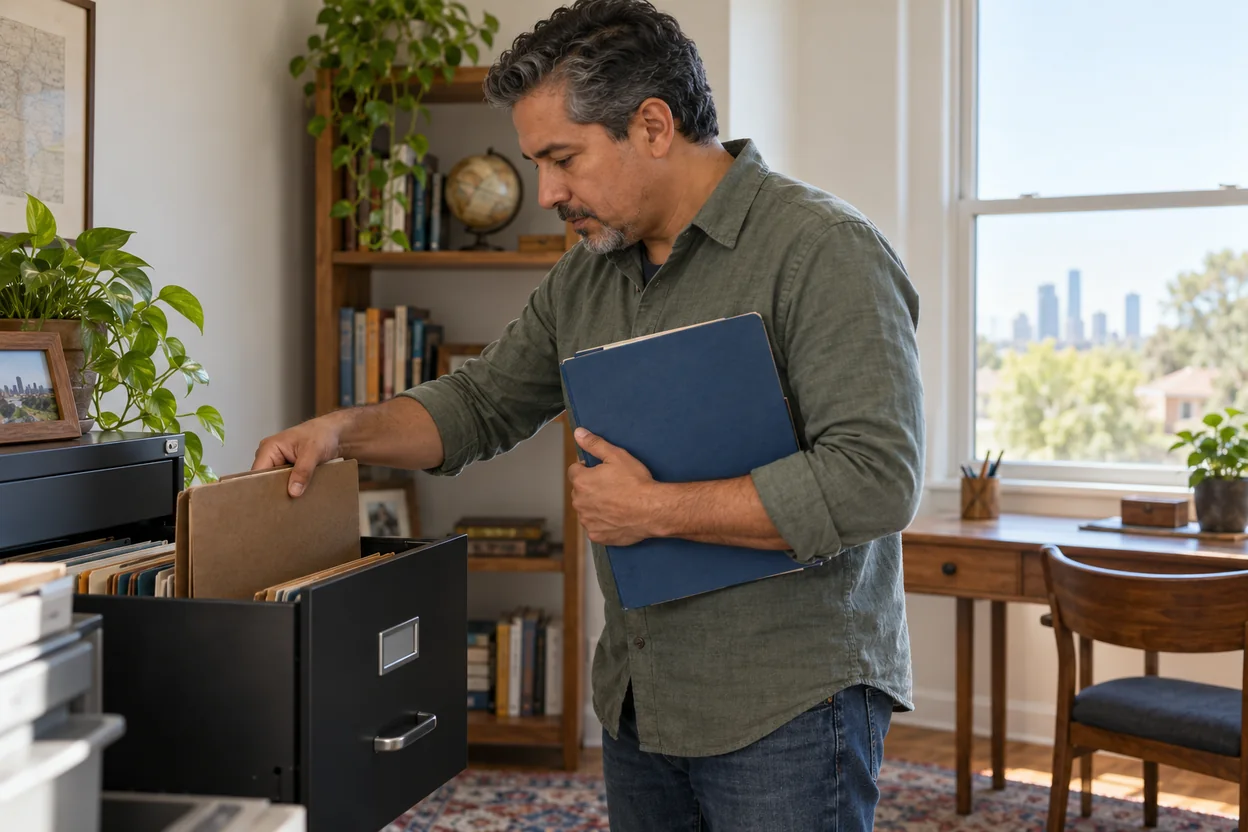
Man retrieving a folder from his personal archive

Read each question fully and follow its instructions, including any directions to skip a field or enter an answer such as none or N/A. When an answer depends on your filing category or immigration history, resolve it from the instructions and your records rather than guessing.

These groups of information deserve a careful cross-check:

If columns extend beyond the view, swipe the table horizontally or focus it and use the arrow keys.

Information requestedWhat to compare
Names and identifying detailsIdentity documents, prior filings, and any records explaining name changes
Filing categoryThe petition or other legal basis supporting the application
Entries and immigration historyPassports, arrival records, notices, and earlier applications
Addresses, activities, and familyThe periods and relationships requested by the current form
Admissibility and additional informationThe full question, applicable instructions, and relevant immigration or court records
Declarations and signaturesThe applicant, interpreter, and preparer sections that apply

A difference between records needs an accurate explanation where required. Take particular care with questions about arrests, immigration violations, and other admissibility issues. Our family immigration team can review how those facts affect a marriage-based filing before you submit it.

Gather the evidence for your filing category

Use the official instructions and the checklist for your category. There is no single document list for every I-485 applicant. Depending on the basis for filing, the evidence may include:

  • identity and birth records, with a complete certified English translation when required
  • the petition, status, or other basis supporting adjustment
  • records of inspection and admission or parole, or evidence of an applicable exception
  • Form I-864, Affidavit of Support, when required for the category
  • Form I-693 or the required portion of that medical examination form

If USCIS requires Form I-693 with your filing, include it with Form I-485. Omitting it can lead to rejection. For a paper submission, keep the civil surgeon's original envelope sealed; for any filing method, follow the medical-document instructions for your category and filing channel.

Employment authorization through Form I-765 and a travel document through Form I-131 are separate requests. Their requirements and fees can differ from the I-485. Check each applicable form page and the current USCIS Fee Schedule rather than assuming that one payment covers every request.

Review the submission before sending it

Once the form and evidence are ready, check the filing steps in this order:

  1. Filing channel: confirm on the USCIS I-485 page whether your category permits online filing or requires paper
  2. Fee and payment: use the current USCIS Fee Schedule and the filing guidance to check the amount, payment instructions, and any applicable exemption
  3. Destination: for paper, use the Direct Filing Addresses for Form I-485; the address depends on the basis for the application and can change

Before sending the submission, make a final check:

  • Form edition: use an accepted edition without pages mixed from different editions
  • Signatures: complete the applicant, interpreter, and preparer signatures that apply
  • Payment: follow the current fee and payment instructions for your request
  • Initial evidence: include the documents required for your category, including Form I-693 when required with the filing

Keep a complete copy of what you submit and proof of delivery or online submission. Careful preparation can catch inconsistencies; it does not guarantee acceptance or approval.

Woman placing a closed document folder in a mailing box

The filing sequence also matters. If you are applying through a spouse, adjustment of status after marriage explains how the petition and residence application fit together in that route.

Follow the notices after filing

After accepting the application, USCIS issues a receipt notice. It may then require biometrics, additional evidence, an interview, or another action. Adjustment applicants are generally interviewed unless USCIS waives the interview in the individual case. Follow each notice for the deadline and documents required.

For an estimate, select the relevant form, category, and office in the USCIS processing times tool. It cannot predict your individual decision date. If you receive a denial, use the written notice to assess the next step; the guide to an I-485 denial explains why the reason and jurisdiction matter.

Practical questions about Form I-485

Can I travel while my I-485 is pending?

Departure can cause USCIS to treat the application as abandoned unless advance parole or a limited status-based exception applies. An approved travel document also does not guarantee parole on return or resolve inadmissibility. In Matter of Delcarmen-Lara, decided August 13, 2026, the Board of Immigration Appeals held that an advance-parole trip counts as a departure for the ten-year bar based on one year or more of unlawful presence, applying that holding prospectively. Review your travel document, the current Form I-131 alerts and instructions, and immigration history before leaving. For a marriage case, our explanation of a marriage green card after an overstay addresses that separate issue.

Can I send the medical examination later?

If USCIS requires Form I-693 or part of it with your I-485, submit it with the application or USCIS may reject the filing. For paper submissions, keep the civil surgeon's envelope sealed. Follow the instructions for your category and filing channel.

Does filing Form I-485 let me work?

No. A pending I-485 does not itself authorize employment. You need existing employment authorization from another valid basis or an approved Form I-765 with authorization that has taken effect.

How do I correct an error after filing?

Check your receipt notice and USCIS online account for the channel applicable to the pending case. USCIS e-Request may address a typographic error USCIS made on a notice, document, card, or case status; it is not a general way to correct an answer you entered. Address a material error promptly and obtain case-specific advice if the correction could affect eligibility or admissibility.

Can someone who entered without inspection adjust status?

Ordinary adjustment under INA section 245(a) generally requires inspection and admission or parole. Other provisions, including section 245(i) and certain VAWA-based cases, may change the analysis. They do not create an automatic exception for everyone; the complete entry history and filing basis must be reviewed.

Are work and travel requests covered by the I-485 fee?

Do not assume they are. Forms I-765 and I-131 are separate requests, and fees depend on the category, filing date, method, and applicable exemption. Check the current form pages and USCIS Fee Schedule immediately before filing.

What is the difference between I-130 and I-485?

Form I-130 establishes a qualifying family relationship for immigration purposes. Form I-485 requests permanent residence for an eligible applicant in the United States. Some cases allow concurrent filing, but an approved petition alone does not grant residence or establish every adjustment requirement.

Before submitting a marriage-based I-485, contact our team to review the questions your records raise. Have your entry history, earlier filings, and supporting documents ready so we can identify what still needs attention.

VAWA Approval Rate by the Numbers — What USCIS Data Shows

7 minute read

The true likelihood of VAWA approval stands high, with USCIS approving 87.3% of VAWA self-petitions according to Form I-360 performance data for fiscal year 2025. This significant VAWA approval rate demonstrates the program’s effectiveness in protecting survivors of abuse.

Your specific chances depend on the evidence you gather and how well your petition addresses USCIS requirements. Our VAWA attorneys work through these factors with each client to build the strongest possible case.

A person reviewing their VAWA petition documents in a supportive legal office environment.

VAWA approval rates by petitioner category

Overall VAWA approval statistics show a consistent trend of high success. According to USCIS Form I-360 performance data for fiscal year 2025, 87.3% of VAWA self-petitions received approval. This strong performance indicates that petitions meeting legal criteria have a high probability of success.

However, the specific approval rate can vary slightly depending on the relationship between the petitioner and the abuser. These distinctions highlight the importance of understanding the precise requirements for your category.

Approval rates for spouses

Spouse-based VAWA petitions consistently show the highest approval rates. In fiscal year 2025, approximately 88% of these petitions were approved. This reflects the program’s primary focus on spouses subjected to battery or extreme cruelty by a U.S. citizen or lawful permanent resident.

Approval rates for children

For children who have been abused by a U.S. citizen or lawful permanent resident parent, the VAWA approval rate was approximately 82% in fiscal year 2025. While slightly lower than spouse-based petitions, this remains a strong indicator of success for eligible child petitioners.

Approval rates for parents

Parents who have been abused by a U.S. citizen son or daughter can also self-petition under VAWA. In fiscal year 2025, parent-based VAWA petitions had an approval rate of 79%. This category is typically less common but can provide a path toward safety and legal status for eligible petitioners.

Factors that strengthen your VAWA petition

Beyond the general VAWA approval rate statistics, specific elements within your petition can increase your odds of approval. USCIS evaluates VAWA petitions based on an “any credible evidence” standard, meaning no single piece of evidence is strictly required, but gathering various forms of support strengthens your chances of approval.

We often observe that petitioners tend to overemphasize certain aspects of their abuse while overlooking key details about their abuser’s status or the specific type of evidence USCIS values most for corroboration. Focusing on these key areas can improve your approval odds.

Corroborating evidence and its impact

The strength and variety of your supporting evidence directly correlate with higher approval rates. Petitions that combine police reports, medical records, protective orders, and affidavits from third parties — such as friends, family, therapists, or shelter workers — consistently perform better. Multiple independent sources of evidence strengthen credibility on every element USCIS evaluates.

This data underscores that while your personal declaration is foundational, external evidence provides essential objective support for your claims of battery or extreme cruelty, as well as your good moral character. The more varied and consistent your evidence, the stronger your petition becomes.

Detailed personal statements

Your personal statement is perhaps the most important piece of evidence you submit. It must provide a detailed narrative of the abuse you experienced, including specific dates, locations, and descriptions of incidents. Insufficient detail in personal statements is, in our experience, the most common trigger for a Request for Evidence (RFE) from USCIS.

A well-crafted statement articulates not only the abuse but also your good faith marriage or relationship, the abuser’s U.S. citizenship or lawful permanent resident status, and why you meet the specific eligibility criteria for VAWA.

Organizing police reports, medical records, and witness affidavits for a VAWA petition.

Common pitfalls and reasons for VAWA denials

While the overall VAWA approval rate is high, denials do occur, often due to specific deficiencies in the petition. Denial rates correlate directly with the completeness and persuasive quality of the submitted evidence. Addressing these issues early also helps keep your VAWA case timeline on track, since RFEs can add months to processing.

Failing to establish a qualifying relationship

One primary reason for denial is the failure to adequately prove a bona fide (“good faith”) marriage or relationship to the abuser. USCIS must be convinced that the marriage was entered into for love and not solely for immigration benefits.

Our marriage-based immigration attorneys can help document this relationship alongside your VAWA case. Even if the abuse is clear, if the relationship itself is not convincingly established, the petition may be denied.

Insufficient documentation of abuse

Although the “any credible evidence” standard is flexible, a lack of documentation or weak evidence of battery or extreme cruelty can lead to denial. This often happens when petitioners rely solely on their own testimony without any corroborating evidence, or when their testimony lacks the necessary detail and consistency that USCIS expects.

Weak witness statements and undocumented immigration violations

Unconvincing or vague witness statements from others can also weaken a case. Furthermore, failing to address any prior immigration violations, such as entering the U.S. without inspection or previous deportation orders, is a common mistake.

While these do not automatically disqualify a VAWA petitioner, they must be properly documented and often require the help of immigration waivers attorneys to address properly.

Good moral character and its impact on approval

A core requirement for VAWA eligibility is demonstrating good moral character. This criterion assesses your overall conduct and adherence to the law. Understanding how USCIS evaluates this directly impacts your VAWA approval rate, especially if you have a complex personal history.

Automatic disqualifiers

Certain criminal convictions can automatically disqualify a petitioner from showing good moral character, making it extremely difficult to demonstrate good moral character. These include serious offenses like aggravated felonies, drug trafficking, or murder. If you have such convictions, we recommend seeking legal counsel to determine if any other immigration pathways are available to you.

An official USCIS approval notice for a successful VAWA self-petition on a desk.

Immigration violations and other issues

Unlike certain criminal convictions, prior immigration violations, such as entering the U.S. without inspection or previous deportation orders, do not automatically disqualify a VAWA petitioner. However, these issues must be clearly documented and addressed within the petition, often requiring the filing of specific waivers.

Our team understands how to present a nuanced picture of your past, explaining the context of any violations and demonstrating that you otherwise meet the good moral character requirement. The goal is to show that any past issues do not reflect your current character and are outweighed by the qualifying abuse.

If you are unsure about the strength of your evidence, whether your relationship qualifies, or how past immigration violations might affect your VAWA petition, contact our team and we will look at it with you.

Frequently asked questions about VAWA approval rates

What if I don’t have police reports or medical records for my VAWA case?

Not having police reports or medical records does not automatically lead to denial. USCIS operates on an “any credible evidence” standard. We help petitioners gather alternative corroborating evidence, such as affidavits from friends, family, or therapists, school records, work evaluations, or detailed personal declarations that consistently describe the abuse and its impact.

Can I still get VAWA if I have a past immigration violation like an old deportation order?

Prior immigration violations, including an old deportation order or entering without inspection, do not automatically disqualify a VAWA petitioner. These issues must be thoroughly documented within your petition and often require specific waivers. Our team works to present these situations within context, demonstrating your good moral character despite past violations.

How does USCIS assess “extreme cruelty” if there’s no physical violence?

USCIS recognizes that extreme cruelty extends beyond physical battery, encompassing severe psychological abuse, emotional manipulation, financial control, or isolation. Documenting such abuse requires a very detailed personal statement, supported by evidence like therapy records, emails, text messages, or affidavits from individuals who witnessed the emotional impact or controlling behavior.

Does my abuser’s criminal history affect my VAWA approval chances?

Your abuser’s criminal history primarily serves to help corroborate the abuse you experienced or establish their U.S. citizen or lawful permanent resident status, if applicable. Their record typically does not impact your eligibility or good moral character requirements directly, as the petition focuses on your experience as the survivor.

What happens if my abuser denies the abuse when USCIS contacts them?

USCIS generally does not contact abusers directly for VAWA petitions to avoid placing the petitioner in further danger. The agency evaluates your case based on the comprehensive evidence and declarations you submit. Therefore, the strength of your own documentation and testimony matters most, not anticipating their denial.

Can I file for VAWA if I was never legally married to my abuser?

VAWA eligibility extends beyond legal spouses. Children abused by a U.S. citizen or lawful permanent resident parent, and parents abused by a U.S. citizen adult child, can also self-petition. In some cases, individuals in a good faith but potentially invalid marriage may also qualify if they meet all other criteria.