If you are preparing for a USCIS adjustment interview, marriage green card interview questions can feel intensely personal. They help the officer evaluate whether your marriage is genuine and whether the record supports eligibility, not whether you can deliver a memorized story.
Examples can make practice less stressful, but USCIS does not use one guaranteed list. The officer may ask about your relationship, wedding, home, finances, family, and recent events, then compare those answers with the forms and evidence in your file.
Common marriage green card interview questions
There is no exhaustive script for marriage green card interview questions. What comes up depends on your forms, your supporting evidence, your immigration history, and any point the officer needs to clarify.
These marriage green card interview questions show the subjects that may come up without predicting what an officer will ask in your case:
- Relationship history: Where and when did you meet? What was your first date? When did the relationship become serious? Who proposed, and how? When did you decide to marry?
- Wedding: When and where did you marry? Who attended? How did you celebrate? Did you take a trip afterward? Which relatives or friends helped with the event?
- Home and daily life: What is your current address? How many rooms are in your home? Who wakes up first? Who cooks? What did you do together yesterday?
- Finances and responsibilities: Do you share bank accounts or insurance? Who pays the rent or mortgage? How do you divide household expenses? Have you filed taxes together? Have you made major purchases together?
- Family and friends: Have you met each other’s parents or siblings? When did you last see them? Which holidays do you celebrate together? Who are your mutual friends? Do you have children together?
- Recent events and plans: What did you do last weekend? What gifts have you exchanged recently? Do you have upcoming travel or family plans? Where do you expect to live? What has changed since you filed?
The purpose is not to invent a perfect answer. It is to describe your real shared life clearly, including ordinary details that fit the record you submitted.

Review your file and answer truthfully
Use the marriage green card interview questions above to identify which parts of the file deserve a careful review. Our broader green card interview tips explain how to organize that preparation without turning your answers into a rehearsed script.
If your memory differs from a form or from your spouse’s answer, do not guess. State what you remember, explain the context honestly, and correct a genuine error when appropriate. No rule makes a small difference harmless, and no polished answer predicts approval.
Evidence USCIS may review
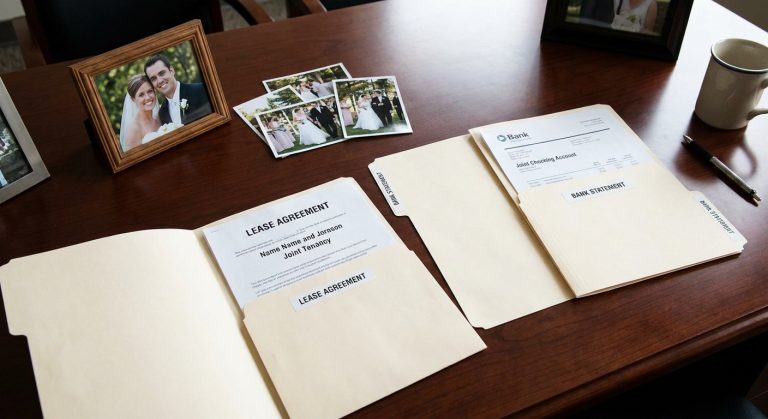
The evidence in your file may shape the marriage green card interview questions you receive. The official USCIS evidence examples introduce the list this way: “You should submit one or more of the following types of documentation that may prove you have a bona fide marriage:”
That list includes property, shared residence, children, affidavits, and “Documentation showing that you and your spouse have combined your financial resources;” USCIS presents possible categories, not a universal ranking. The value of any item depends on whether it is authentic, relevant, and consistent with the rest of the record.
If columns extend beyond the view, swipe the table horizontally or focus it and use the arrow keys.
| Type of evidence | Examples that may fit the record |
|---|---|
| Shared residence | Lease, mortgage, property records, utility bills, or mail showing the same address. |
| Combined finances | Joint account statements, tax records, insurance, or evidence of shared expenses. |
| Children | Birth certificates, adoption records, or school and medical records naming both parents. |
| Third-party knowledge | Affidavits from people with personal knowledge of the relationship. |
| Shared life | Photos over time, travel records, memberships, correspondence, or other relevant records. |
Use the interview notice as your checklist for originals, updated records, and anything USCIS specifically requests. A focused file should make relevant items easy to locate, but organization does not replace the need to prove eligibility.

Follow the interview notice
The federal adjustment interview rule provides for an interview unless USCIS determines that one is unnecessary. The appointment notice remains the practical source for the instructions that apply to your case.
Do not assume that both spouses must appear in every case or that the appointment will last a set number of minutes. Read the notice for the date, location, documents, and people USCIS directs to attend. If the interview is waived, follow any later notice instead.
If an attorney or authorized representative will attend, follow the notice and current USCIS instructions for that appearance. A representative does not replace either spouse’s personal answers, but our family immigration attorneys can address legal and procedural issues within that role.
USCIS may also use separate questioning when the officer needs to examine the relationship more closely. That phrase is more accurate nationwide than treating “Stokes interview” as an official national label. Each spouse should answer from personal knowledge and explain uncertainty rather than trying to reproduce identical wording.
A K-1 visa interview is different
A K-1 interview is a consular visa step for a fiance or fiancee before marriage and entry to the United States. If that is your process, the relevant k1 visa interview questions belong to a different interview and should not be mixed with these USCIS adjustment examples.
What can happen after the interview
A decision may be issued at the interview, but it is not guaranteed to be immediate. Depending on the record and applicable procedures, USCIS may approve, continue reviewing, request specific evidence, issue a notice of intent to deny, or deny. If an I-485 is denied, the available next steps depend on the decision and the facts of the case.
The official USCIS guidance on evidence requests and notices of intent to deny explains that an officer may issue an RFE or NOID or may deny when the record does not establish eligibility. An RFE is one possibility, not a promised step before an unfavorable decision.
- Approval: USCIS may approve when the record establishes eligibility.
- Further review: the officer may continue reviewing the file or take another procedural step.
- RFE or NOID: USCIS may request evidence or give notice of an intended denial when applicable.
- Denial: USCIS may deny when the record does not establish eligibility and the governing procedure permits a decision.
The interview is one stage within adjustment of status after marriage. Continue following every USCIS notice and the case record after the appointment rather than relying on a general prediction about timing.

If USCIS grants a conditional Green Card through a qualifying marriage, removing those conditions is a separate later process. The current I-751 processing time is also a separate question from interview preparation and the filing instructions for Form I-751.
If your forms, evidence, or history raise questions that a sample list cannot resolve, our marriage immigration attorneys can review the record with you, identify issues that deserve careful explanation, and help you prepare truthful answers for the interview USCIS has scheduled. The goal is clear, accurate preparation based on your own marriage and immigration history.
Frequently asked questions about marriage green card interviews
What if my spouse and I don’t share any financial accounts yet?
Joint accounts are one possible form of evidence, not a requirement that fits every household in the same way. Explain truthfully why you do not have them and do not create records only for the interview.
Bring other relevant evidence that reflects your ongoing marital union, such as shared bills, insurance, housing records, correspondence, or proof of joint responsibilities. USCIS evaluates those items in the context of the complete record.
Can a lawyer attend the green card interview with us?
A person involved in an immigration examination has the right to representation by an attorney or authorized representative. Follow the interview notice and any USCIS instructions concerning the representative’s appearance.
The lawyer cannot replace either spouse’s personal testimony or answer relationship questions for the couple. The lawyer may address legal and procedural issues that arise within the permitted role.
What if there are minor inconsistencies between our answers?
Do not guess or force an answer to match your spouse’s wording. State what you remember, acknowledge uncertainty, and give truthful context if a form or earlier answer was inaccurate.
USCIS considers any difference with the rest of the record, and there is no universal rule that a particular inconsistency is harmless. The significance depends on what the difference concerns and how it relates to eligibility.
How long after the interview will we get a decision?
There is no single official decision period that applies after every marriage adjustment interview. A decision may be immediate, or USCIS may continue reviewing the record.
Follow the case status and every notice USCIS sends instead of relying on a universal estimate. The next step may depend on the evidence, the issues in the file, and the procedure USCIS applies.
Are some types of evidence more persuasive than others for a bona fide marriage?
USCIS lists examples such as shared property, residence, finances, children, and affidavits, but it does not establish one universal hierarchy for every marriage. Different couples may have different relevant records.
An item’s value depends on its authenticity, continuity, context, and consistency with the rest of the file. Explain gaps honestly and submit evidence that reflects how your relationship actually works.
What should we do if USCIS sends a Request for Evidence (RFE) after our interview?
Read the RFE closely, identify each item USCIS requests, and respond by the deadline stated in the notice. Organize the response so the requested evidence and explanations are easy to locate.
An RFE does not guarantee approval after you respond, and USCIS does not have to issue one in every case. Depending on the record and governing procedure, USCIS may issue an RFE or NOID, continue review, or make a decision.