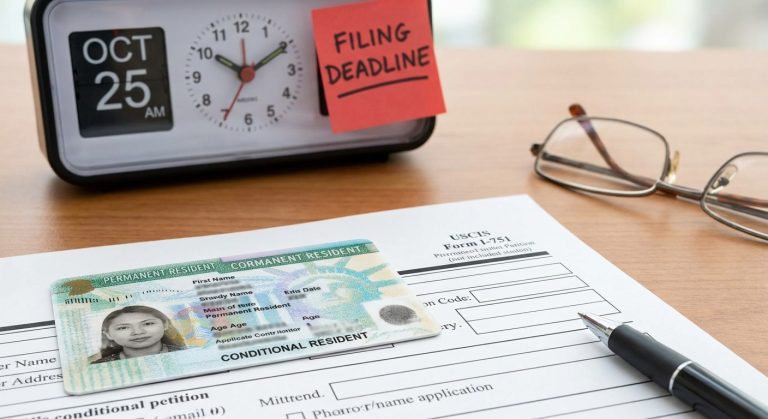
To remove the conditions on your conditional green card and become a full permanent resident, you file Form I-751, Petition to Remove Conditions on Residence. For most couples filing jointly, it must be submitted within the strict 90-day window right before your conditional status expires.
Filing outside that window risks rejection and can put your lawful status at risk, which is exactly why the timing matters so much. Our green card immigration lawyers can guide you through the process and the deadlines.
Why you received a conditional green card
You received a conditional green card, valid for two years, because your marriage to a U.S. citizen or permanent resident was less than two years old on the day your residency was granted, often through adjustment of status after marriage.

The conditional period is not a punishment or a sign of doubt. It is a check that lets USCIS confirm, after two years, that the marriage was entered in good faith and not just for an immigration benefit.
Removing these conditions is the final step to a permanent, ten-year green card.
When to file Form I-751 to remove conditional status
The timing of Form I-751 decides whether you keep your lawful status, and it depends on whether you file jointly with your spouse or request a waiver.
The 90-day window for joint petitions
If you file jointly, Form I-751 must be submitted within the 90-day period right before your conditional green card expires. Filing too early, even by a few days, can lead USCIS to reject the petition and make you resubmit it.
The 90-day window is what trips up most applicants. Missing the deadline has real consequences.
Filing late, without a reason USCIS accepts, automatically terminates your conditional resident status, and USCIS can start removal proceedings before an immigration judge.
Automatic status extension
When you file on time, USCIS issues a receipt notice (Form I-797C) that automatically extends your conditional resident status for 48 months from the expiration date on your card. That lets you keep living and working in the U.S. while the petition is pending, even if it takes longer than two years.
Filing late for good cause
The 90-day window is strict but not absolute. USCIS may accept a late I-751 if you show “good cause” for the delay with a credible explanation, such as serious illness, unforeseen travel, or other extraordinary circumstances. The more detailed and well-supported your explanation, the better the chance USCIS accepts it.

Filing Form I-751 jointly with your spouse
When you and your spouse file together, the heart of the petition is proving your marriage is genuine. That means documents showing your intertwined lives: living together, sharing finances, and being recognized as a couple.
Proving a bona fide marriage
The goal is a complete picture of your life together. Quality and variety matter more than sheer volume; the more angles you can show, the stronger the petition. Before mailing it, check the USCIS page for Form I-751 to confirm the current filing address, since it can change.
Categories of evidence
Pull evidence from several categories to establish a genuine marriage:
- Financial commingling: joint bank statements with regular activity, joint credit card statements, joint tax returns, and shared debts or investments.
- Joint property: a mortgage or lease in both names, property deeds, and vehicle titles.
- Children of the marriage: birth certificates listing both spouses as parents, which is strong evidence of a shared life.
- Insurance: health, life, or auto policies naming the other spouse as a beneficiary or policyholder.
- Affidavits from others: statements from friends, family, or employers who know you as a couple, with their full name, address, and how they know you.
- Other proof: photos from different points in your marriage, travel taken together, utility bills in both names, and joint memberships.
If you originally filed through marriage, our marriage-based green card attorneys can help you pull this evidence together. The strength of the petition is in the consistency of proof across these areas.
Filing an I-751 waiver without your spouse
Life can change in ways that make joint filing impossible or unsafe. In those cases, you may file an I-751 waiver to remove the conditions without your spouse. Unlike joint petitions, a waiver can be filed at any time before your conditional status expires.
Your spouse has passed away
If your petitioning spouse died, USCIS treats your filing as an individual filing request rather than a waiver. You submit a copy of the death certificate and evidence that the marriage was entered in good faith, the same as a joint petition requires.
The USCIS Policy Manual lists this basis separately from the waiver categories below, and that distinction affects how you fill out the form.
A good-faith marriage that ended
This waiver applies if you married in good faith but the marriage later ended in divorce or annulment. You submit a certified copy of the final divorce decree or annulment order, which must be final before you file, plus evidence that the marriage was genuine from the start until it ended.
Battery or extreme cruelty
If you or your child suffered battery or extreme cruelty from your U.S. citizen or permanent resident spouse, you can file a waiver. It calls for affidavits and supporting documents such as police reports, court records, medical records, or witness statements. Our immigration waiver attorneys handle these sensitive cases and can help you gather documentation while protecting your privacy.
Extreme hardship
You may qualify if losing your status and being removed would cause extreme hardship to you, not to a relative. This is a high standard. It can include serious medical needs that cannot be met in your home country, severe psychological impact, or loss of access to essential support.
USCIS only counts hardship that happened during your two-year period of conditional residence. Circumstances arising before that period began or after it ended do not count toward this standard.
What happens after you file
Once your I-751 is submitted, you enter a review period that can run a long time. Knowing the usual sequence helps you set expectations.
The I-797C receipt notice
USCIS first sends a Form I-797C, Notice of Action, confirming it received your petition. This notice automatically extends your conditional resident status for 48 months from the expiration date on your card, so keep it with your expired card as proof of status for travel and work.
Biometrics appointment
Soon after, USCIS schedules a biometrics appointment at an Application Support Center, where your fingerprints, photograph, and signature are collected for background and identity checks.
Request for Evidence or interview
USCIS may send a Request for Evidence if it needs more documents, so respond fully and on time. Not everyone is interviewed, but USCIS can call you and your spouse (for joint filers) or a waiver applicant to an I-751 interview to confirm the petition and the marriage.

Processing times
I-751 processing can be long, often well over two years, and waiver petitions can take longer still. Because the numbers shift, check the current I-751 processing times and the USCIS processing times page before counting on a date.
If you already have a permanent green card and are approaching its own expiration, the current green card renewal processing time covers that separate timeline.
If you are unsure about your exact 90-day window, how to gather enough evidence of a bona fide marriage, or which waiver applies to your situation, contact our team and we will look at it with you.
Frequently asked questions about removing conditional green card status
How can I accurately determine the 90-day filing window for my I-751 petition?
Find the expiration date on your conditional green card and count back 90 calendar days. The window begins on that 90th day and ends on the expiration date. Filing within this specific period is what keeps your lawful status intact.
What happens if my marriage ends in divorce while our joint I-751 petition is still pending?
If you divorce while a joint I-751 is pending, you generally notify USCIS and convert the petition to a waiver. You then file an amended I-751 with the final divorce decree and evidence that the marriage was bona fide at its inception.
What kind of situations does USCIS consider “good cause” for late I-751 filing?
Good cause usually involves circumstances beyond your control, such as a severe illness that prevented timely action, military deployment, or the death of a close family member that affected your ability to file. Extensive documentation supporting the explanation is important.
Can I travel outside the U.S. if I only have an I-797C receipt notice for my pending I-751?
Yes. The I-797C receipt notice typically extends your conditional resident status for 48 months, which allows international travel. Carry both your expired conditional green card and the valid I-797C notice to show your continued lawful status.
My conditional green card expired and I forgot to file the I-751. What should I do now?
If it expired without filing, your status may have automatically terminated. You might still file the I-751 late if you can show “good cause” for the delay. Acting quickly to assess your options and gather supporting evidence is important.
What makes an affidavit from friends or family strong evidence for a bona fide marriage?
Strong affidavits give specific, verifiable details rather than general praise. They explain how the person knows you as a couple, describe shared experiences, and attest to a genuine marital bond, with concrete observations over time.
How difficult is it to prove “extreme hardship” for an I-751 waiver, and what typically qualifies?
It is demanding, since you must show hardship well beyond the usual difficulty of removal. It can involve severe medical conditions needing treatment unavailable abroad, exceptional psychological impact, or loss of essential support systems that cannot be replaced in your home country.