Your citizenship interview follows a clear sequence: you arrive and clear security, a USCIS officer reviews your N-400 and tests your English and civics knowledge, and the day ends with a decision or the next steps toward your Oath of Allegiance. The core steps are consistent, though the exact timing and questions vary by case and officer.
Knowing what happens from the moment you walk in takes a lot of the stress out of the day. Our naturalization attorneys prepare applicants for each stage, from what to bring to how to handle the questions.

Arriving at the USCIS office and checking in
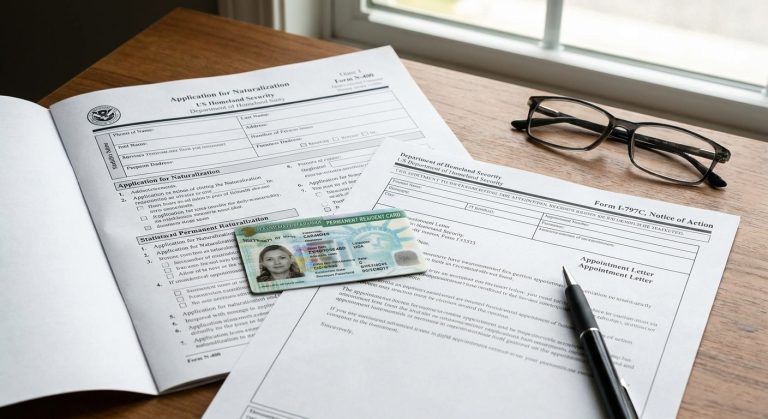
Plan to arrive at least 30 minutes before the time on your appointment notice (Form I-797C). That gives you room to get through security and check in without rushing.
Security and document check
You will pass through a security checkpoint much like an airport, with metal detectors and X-ray screening of your belongings. At the check-in desk, an official verifies your identity and appointment. Have your appointment notice, your Permanent Resident Card (Form I-551), and a state-issued photo ID ready.
After check-in, you wait in a seating area shared with other applicants until an officer calls your name.
What happens during the interview
Once your name is called, an officer takes you to a private office. This is the core of the process: confirming the information in your N-400 and your eligibility for U.S. citizenship.
Review of your N-400 application
The officer first places you under oath, so your answers must be truthful. Then they go through your N-400, asking about your history since you became a permanent resident: personal background, immigration history, employment, marital status, travel, and moral character.
We often see applicants who have not reread their N-400 get caught off guard by specific details. The officer may ask about any arrest or citation, even a minor one, or about long trips or gaps in employment. Be ready to explain anything that changed since you filed.
Bring your documents as well. As of June 2026, that means your appointment notice, your Permanent Resident Card, a state-issued photo ID, and all valid and expired passports and travel documents. Depending on your case, you may also need marriage or divorce certificates, tax returns for the past five years (three if you applied based on marriage to a U.S. citizen), and proof of Selective Service registration if you are a man who was required to register.
The English and civics tests
Unless you qualify for an exemption or waiver, the officer gives you English and civics tests during the interview. The English test has three parts: speaking, reading, and writing. Your speaking is judged throughout the interview as you answer questions, not in a separate segment.
For reading, you read one of three sentences correctly; for writing, you write one of three correctly. Both use simple sentences about civics or everyday life.
The civics test depends on when you filed your N-400. If you filed before October 20, 2025, you take the 2008 test: up to 10 questions from a list of 100, with 6 correct to pass. If you filed on or after October 20, 2025, you take the 2025 test: 20 questions from a list of 128, with 12 correct to pass. Either way, the full list is public, and our guide to the citizenship test walks through how to study it.

Possible outcomes after your interview
At the end, the officer hands you Form N-652, Naturalization Interview Results, which summarizes the interview and shows one of these outcomes:
- Granted: the officer finds you eligible, and your case moves on to the Oath of Allegiance ceremony.
- Continued: the officer needs more documents or clarification, or you did not pass the English or civics test. You receive a Request for Evidence or a notice to return, usually with a date to retake only the part you failed. You generally get one more attempt.
- Denied: if you are found ineligible, you receive a written explanation and information on how to appeal.
USCIS has 120 days from your interview to issue a decision. If it does not, you can ask a federal district court to review your application. Our naturalization lawyers can step in if your case stalls or is denied.
The Oath of Allegiance ceremony
A “Granted” result means you are close, but you are not a citizen until you take the Oath of Allegiance at a ceremony.

Attending the ceremony
The wait between the interview and the ceremony ranges from the same day to several months, depending on your field office and how often it holds ceremonies. For a fuller picture, see how long naturalization takes from start to finish. You receive a Form N-445 with the date, time, and location.
On ceremony day, arrive early. At check-in, officials verify your identity and review your answers on Form N-445, which asks about any changes since your interview. You then take the Oath of Allegiance in a group ceremony and receive your Certificate of Naturalization.
If you are unsure what to bring, how to answer a particular question, or what your path to the ceremony looks like, contact our team and we will look at it with you.
Frequently asked questions about your naturalization interview
What if I have an old arrest record or minor traffic tickets on my N-400?
Any arrest or citation, even a minor one, is usually reviewed by the officer during your interview. Bring all related court dispositions and arrest records, and be ready to explain the circumstances truthfully. Having the paperwork organized in advance makes the conversation much smoother.
How long should I expect to be at the USCIS office for the entire process?
Plan for at least two to three hours from arrival to departure. That accounts for security, waiting time, the interview itself, and any administrative steps afterward. Arriving about 30 minutes early helps keep the day on schedule.
Can I reschedule my naturalization interview if an emergency happens?
Yes, you can generally request to reschedule for an unforeseen emergency. Follow the instructions on your interview notice and submit the request promptly, usually in writing with an explanation. Keep in mind that rescheduling can add significant delay to your case.
What happens if I don’t pass one or both parts of the English and civics tests?
If you do not pass a component, your case is usually continued and you receive a notice for a second interview. The notice lists a date to retake only the part you failed. You generally get one more opportunity to pass.
Do I need to bring my children or dependents to the citizenship interview?
Generally no, unless they are named on your interview notice or USCIS specifically tells you to. Offices often have limited space and do not provide childcare, so it is usually best not to bring dependents.
What if my personal information changed since I submitted my N-400?
Tell the officer about any significant change to your information or eligibility, such as marital status, address, employment, or travel. Bring updated documents to support the change so the officer can review it on the spot.