8 minute read
With the overall USCIS backlog more than tripling over the last decade, reaching over 11.6 million pending cases as of 2026, many wonder whether to continue waiting for their green card or take proactive steps.
This reality means that while the path to permanent residence can feel long, clarity on your situation allows for effective planning. Our green card attorneys can help explain these timelines and specific strategies for your case.

Why the green card backlog causes long waits
Your green card timeline can feel uncertain because the delays are not just processing backlogs, but a structural issue rooted in U.S. immigration law itself.
Congress sets annual numerical limits for immigrant visas, a system established decades ago that has not kept pace with global demand. This framework allocates a limited number of visas across various family-sponsored and employment-based categories each fiscal year. As of June 2026, these limits constrain the number of green cards issued, irrespective of how many eligible applicants there are.
Annual visa quotas and per-country caps
Beyond the overall annual limits, a statutory 7% per-country cap applies to both family-sponsored and employment-based preference categories. This means no single country can receive more than 7% of the total visas available in a given year.
For highly populous countries with high demand for U.S. immigration, such as Mexico, the Philippines, the Dominican Republic, India, and Bangladesh, this cap creates disproportionately long waiting lists. For instance, while the annual limit for Family Preference visas is 226,000, there were more than 3.7 million people on the waiting list as of November 1, 2023.
The overwhelming demand from these countries, coupled with the fixed numerical limits, means that many more eligible applicants exist than there are available visa numbers. This structural imbalance is the fundamental cause of this delay.
These numerical limitations and high demand directly translate into a queue, which is managed and communicated through priority dates and the monthly Visa Bulletin.
How your priority date and the Visa Bulletin affect your wait
Once you understand the systemic reasons for backlogs, the next step is to grasp the tools that track your individual progress within this system, established by your priority date.
For family-based cases, this date is typically when USCIS properly receives Form I-130, Petition for Alien Relative, as of May 2026. For employment-based cases, it is often the date the Department of Labor receives a PERM Labor Certification or USCIS receives Form I-140, Immigrant Petition for Alien Worker.
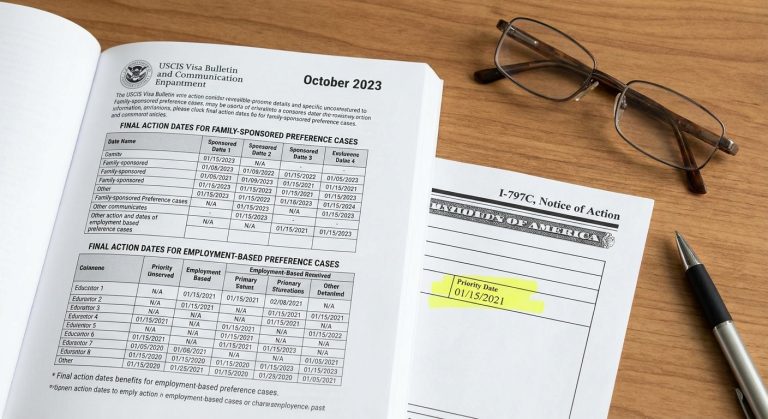
The Department of State publishes the Visa Bulletin monthly to communicate visa availability. This bulletin provides specific dates that determine when immigrant visas may be issued or when adjustment of status applications can be submitted, directly impacting your application’s progress.
Many petitioners assume their priority date will become current predictably, failing to understand how retrogression or specific preference categories can prolong their wait, leading to unexpected setbacks.
Interpreting the Visa Bulletin charts
The Visa Bulletin includes two charts: “Final Action Dates” and “Dates for Filing Applications.” Final Action Dates indicate when an immigrant visa number is available for approval, allowing your green card to be issued or adjustment of status finalized.
Dates for Filing Applications show when you may submit your adjustment of status or immigrant visa application, even if a final visa number is not yet available. USCIS specifies which chart to use for Adjustment of Status filings each month.
Understanding retrogression
Retrogression is a key factor affecting these wait times. It occurs when priority dates move backward, meaning demand has exceeded the available visas for a particular category or country.
For example, the Department of State warned of likely retrogression for worldwide EB-2 and EB-3 final action dates in the July 2024 Visa Bulletin due to high demand. When retrogression happens, a priority date that was previously current may no longer be, forcing applicants to wait longer.
The interpretation of these dates has direct, significant consequences for family-based green card petitioners, shaping their immediate decisions and long-term plans.

What the green card backlog means for your family immigration plans
The impact of the green card backlog differs significantly based on your relationship to the U.S. citizen or lawful permanent resident (LPR) petitioner.
Immediate relatives of U.S. citizens
Immediate relatives of U.S. citizens are generally exempt from annual numerical limits on visas, as verified in May 2026. This category includes spouses, unmarried children under 21, and parents of U.S. citizens who are 21 years or older.
Because they are not subject to the caps, these relatives typically do not face the long waiting lists associated with these delays. Their processing is often dictated by USCIS processing times rather than visa availability. Our marriage-based immigration attorneys help spouses understand and navigate the full process, from the I-130 petition through visa availability.
Family preference categories
All other family relationships fall under preference categories, which are subject to both annual caps and per-country limits, leading to significant wait times. Over 4 million applicants were on the State Department’s immigrant visa waiting list as of a 2023 State Department report, with the overwhelming majority in family-based categories.
- First Preference (F1) Unmarried sons and daughters (21 years of age or older) of U.S. citizens.
- Second Preference (F2A) Spouses and minor children (under 21) of LPRs.
- Second Preference (F2B) Unmarried sons and daughters (21 years of age or older) of LPRs.
- Third Preference (F3) Married sons and daughters of U.S. citizens.
- Fourth Preference (F4) Brothers and sisters of U.S. citizens.
Specific challenges arise, for example, for F2A beneficiaries. If the LPR petitioner naturalizes, the F2A petition can often be “upgraded” to an immediate relative petition, potentially eliminating the wait for a visa number.
However, the wait times can be extensive for other categories, particularly for high-demand countries like Mexico and the Philippines.
The risk of aging out
A significant concern for children in preference categories is “aging out.” If a child turns 21 before a visa number becomes available for their category, they may lose their eligibility as a minor and potentially shift to a less favorable, longer waiting category.
The Child Status Protection Act (CSPA) provides some relief by allowing certain children to “freeze” their age for immigration purposes under specific circumstances, but understanding its application is complex. Our family immigration attorneys can help assess these scenarios.
Strategies for navigating long green card waiting periods
Facing a long green card wait can be frustrating, but inaction is not your only option. Strategic planning and proactive steps can make a substantial difference in managing the backlog’s effects on your case.
Maintaining lawful non-immigrant status
If you are already in the U.S. on a non-immigrant visa (such as an H-1B, F-1 OPT, or O-1), maintaining your lawful status is essential to avoid serious immigration consequences, including potential bars to future adjustment, while awaiting your green card. Allowing your non-immigrant status to expire without a pending adjustment of status application can lead to serious immigration consequences.
Exploring options like extensions of stay or changes of status to another non-immigrant category can prevent a lapse in your legal standing. In some cases, a previous immigration violation or overstay could require the assistance of immigration waiver attorneys to address past violations before adjusting status.
Considering cross-chargeability
For individuals born in countries with severe processing delays, cross-chargeability might offer an alternative.
If your spouse was born in a country with a shorter backlog or no backlog at all, you might be able to “cross-charge” your visa to their country of birth, potentially shortening your wait time. This complex rule applies under specific circumstances and requires careful review of both spouses’ eligibility.
Upgrading your petition
If your petitioner is a lawful permanent resident who naturalizes to become a U.S. citizen while your family preference petition is pending, your petition may be upgraded.
For example, an F2A petition for a spouse of an LPR would upgrade to an immediate relative petition once the LPR becomes a U.S. citizen, often leading to a much shorter wait. Our naturalization and citizenship attorneys can assist with this process for your petitioner.
Adjustment of status versus consular processing
Your location dictates whether you will pursue adjustment of status or consular processing. If you are physically present in the U.S. and meet eligibility requirements, you may apply for adjustment of status.
If you are outside the U.S., you will go through consular processing at a U.S. embassy or consulate abroad. Each path has its own procedural nuances and timelines that can be affected by these backlogs.

Keeping information updated
Regardless of your specific strategy, keeping your contact information and case details updated with USCIS and the National Visa Center (NVC) is essential to avoid missing critical notices or requests for evidence. Changes of address, phone number, or email should be reported promptly.
Even with proactive measures, the specifics of the green card backlog often require counsel that considers your individual circumstances to help you make the best decisions.
If you are unsure about interpreting your specific priority date, how the green card backlog affects your family’s unique situation, or how to maintain your lawful status while awaiting visa availability, contact our team and we will look at it with you.
Frequently asked questions about green card backlogs
My non-immigrant visa is expiring soon, but my green card priority date isn’t current. What should I do?
It’s essential to maintain lawful status to avoid serious immigration consequences. You may need to explore options like extending your current non-immigrant visa, changing status to another eligible category, or leaving the U.S. if your petition is current via consular processing. Our team can assess your eligibility for these alternatives.
How does the Child Status Protection Act (CSPA) help children avoid aging out?
The CSPA allows certain children to “freeze” their age for immigration purposes, preventing them from aging out of a more favorable visa category when they turn 21. This typically involves subtracting the time their Form I-130 petition was pending from their biological age. Its application is complex and depends on specific factors in each case.
Can I travel outside the U.S. while my green card application is pending due to backlog?
Traveling while your green card application is pending can be risky, especially if you filed for Adjustment of Status without advance parole. Leaving the U.S. without proper authorization could lead to your application being denied or prevent your re-entry. It is important to consult with our attorneys before making any travel plans.
What exactly is ‘cross-chargeability,’ and when can it shorten a green card wait?
Cross-chargeability is a rule allowing you to be “charged” to your spouse’s country of birth for visa quota purposes if that country has a shorter backlog. This can significantly reduce your waiting time if you were born in a country with severe delays. It applies under specific circumstances, requiring careful review of both spouses’ eligibility.
Does marrying a U.S. citizen always mean a faster green card process?
While spouses of U.S. citizens are considered “immediate relatives” and are exempt from annual visa quotas, which means they do not face green card backlogs for visa numbers, their processing still involves USCIS application timelines. These processing times vary and are not always immediate, though generally faster than preference categories.
Beyond the Visa Bulletin, how can I track my green card case’s progress effectively?
You can track your case online using the receipt number provided by USCIS or the National Visa Center (NVC). Staying informed also involves promptly updating your contact information with both agencies to ensure you receive all notices. For specific concerns, our team can help you inquire about your case status.