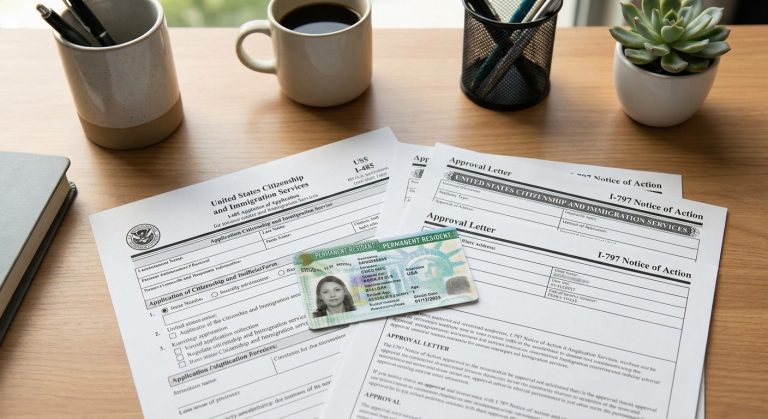
Form I-485, the Application to Register Permanent Residence or Adjust Status, is the form you file to become a lawful permanent resident without leaving the United States. It is the form behind the process known as adjustment of status.
Filling it out correctly matters, because a single blank field, an outdated edition, or a missing document can trigger a rejection. Our green card lawyers can review your forms and packet before you send them to USCIS.

How to fill out Form I-485
Most of the I-485 is manageable once you know what each section asks for. Work through it in order, answer every question, and never leave a field empty. Write “none” or “not applicable” when a question does not apply to you.
Use the current edition and read the instructions
USCIS only accepts the current edition of the form. As of June 2026 that is the 03/13/26 edition, and older versions are rejected, so confirm the latest edition on the USCIS I-485 page before you start.
Download the official instructions as well. They explain each part of the form line by line and list the evidence USCIS expects for your category.
Complete each section accurately
The form is divided into several sections. Here is what the main ones ask for and how to handle them:
If columns extend beyond the view, swipe the table horizontally or focus it and use the arrow keys.
| Section | What it asks for | Tip |
|---|---|---|
| Information about you | Legal name, date of birth, A-Number, and immigration history | Use the exact details from your other USCIS records |
| Filing category | The category you are adjusting under | Match it to your underlying petition (I-130, I-360, and others) |
| Address and work history | Where you have lived and worked | Cover the full period with no gaps in the dates |
| Biographic information | Height, weight, eye and hair color, race and ethnicity | This section replaces the old Form G-325A |
| Inadmissibility questions | Arrests, prior immigration violations, public charge factors | Answer truthfully; a waiver may be available if a ground applies |
| Signature | Your signature, plus interpreter or preparer details if used | An unsigned form is rejected automatically |
Take extra care with the inadmissibility questions. An inaccurate answer there can create a bigger problem than the issue you were worried about.
Avoid the mistakes that get applications rejected
A handful of errors cause most rejected I-485 packets:
- Using an outdated edition of the form.
- Leaving fields blank instead of writing “none” or “N/A.”
- Forgetting to sign, or signing with a stamp or a typed name.
- Not including Form I-693 when it is required. As of late 2024, USCIS may reject the I-485 without it.
Catching these before you mail the packet saves months of delay.

Documents you must include with the I-485
The form is only part of the filing. A complete I-485 packet also includes supporting documents, and a missing one is a common reason applications stall.
Here is what you typically need to include:
- Two passport-style photos, 2×2 inches, taken within 30 days.
- A copy of a government-issued photo ID, such as your passport biographic page.
- A copy of your birth certificate, with a certified English translation if it is not in English.
- A copy of your Form I-94 showing lawful entry into the U.S.
- A copy of the approval notice (Form I-797) for your underlying petition.
- Form I-693, the medical exam, completed by a USCIS-authorized civil surgeon and sealed in its envelope.
- Form I-864 for family-based cases, where the affidavit of support shows the petitioner can support you financially.
If you also want a work permit or travel document while your case is pending, you can file Forms I-765 and I-131 at the same time. For applications filed on or after April 1, 2024, those carry separate fees.
Who can file Form I-485
Not everyone in the U.S. can adjust status. You generally must be physically present in the country, have an immigrant petition that makes a visa available to you, and have entered lawfully.
Beyond that, eligibility usually depends on:
- A current priority date, for most preference categories, based on the monthly Visa Bulletin.
- Lawful admission or parole, with limited exceptions such as VAWA self-petitioners.
- Admissibility to the U.S. Certain convictions or violations can make you inadmissible, though waivers may help.
Immediate relatives of U.S. citizens
Spouses, unmarried children under 21, and parents of U.S. citizens are immediate relatives, and they are exempt from visa quotas. A visa is always available to them, so they can file the I-485 together with Form I-130 instead of waiting for a priority date.
If you are petitioning for a spouse, our family immigration attorneys can confirm whether you can file both forms together, and checking the green card through marriage requirements early prevents surprises.
How to file the I-485 and what comes next
Once your forms and documents are ready:
- Calculate the correct fees: the I-485 fee, the biometric services fee, and any separate I-765 or I-131 fees.
- Confirm the filing address on the “Direct Filing Addresses for Form I-485” page, since it depends on your category.
- Mail the packet with a tracked service such as USPS Certified Mail, FedEx, or UPS.
If you are adjusting after marrying a U.S. citizen, the same steps apply, with the extra detail covered in adjustment of status after marriage.
After you file
USCIS sends a receipt notice (Form I-797C) within a few weeks, then schedules biometrics and, in most cases, an interview before deciding. If it needs more information, it issues a Request for Evidence.
Processing times vary widely, from several months to over two years depending on your category and field office. Check the current estimate on the USCIS processing times page rather than relying on a fixed number.
If you are unsure how to complete a section, which documents apply to your category, or whether you are eligible, contact our team and we will review your case with you.
Frequently asked questions about the I-485 form
Can I travel outside the U.S. while my I-485 application is pending?
Traveling outside the U.S. while your I-485 is pending generally requires an approved advance parole document, which you request using Form I-131. Leaving without it can be treated as abandoning your adjustment of status application, which leads to denial. It is safer to wait until the travel document is approved before any international trip.
Should I submit the medical exam (Form I-693) with my I-485 application, or can I send it later?
Generally, Form I-693 should be submitted together with the I-485 to avoid delays or rejection. As of late 2024, USCIS may reject an I-485 if the medical form is required and not included. Sending it separately often triggers a Request for Evidence, which extends processing times.
Can I work legally in the U.S. after filing my adjustment of status application?
Filing the I-485 application alone does not grant immediate work authorization. To work legally while the case is pending, you must file Form I-765 for an Employment Authorization Document (EAD). It can be filed together with the I-485 or separately, and you may begin working once the EAD is approved.
What happens if I discover an error on my I-485 application after I have already submitted it?
If you find an error after filing, contact USCIS to ask about correction procedures. Minor typographical errors can sometimes be fixed at the interview. For more significant issues, you may need to submit a written amendment or respond to a Request for Evidence that addresses the problem.
What if I entered the U.S. without inspection; can I still adjust my status with Form I-485?
Generally, you must have been lawfully admitted or paroled into the U.S. to adjust status with Form I-485. Entering without inspection usually makes you ineligible. There are limited exceptions for certain categories, such as VAWA self-petitioners or applicants covered by Section 245(i), which requires a penalty fee.
Are there separate fees for applying for a work permit or travel document with the I-485?
Yes. For I-485 applications filed on or after April 1, 2024, there are separate fees for concurrently filing Form I-765 (Employment Authorization) and Form I-131 (Travel Document). These were previously included in the I-485 filing fee but are now charged separately.