4 min read
Your legal status as a Lawful Permanent Resident does not vanish when your green card expires, but your ability to prove that status disappears immediately. An expired card creates problems with employers, border agents, and benefit eligibility.
This is why a green card renewal application should be submitted six months before your card’s expiration date. Our green card lawyer team reviews every field of your Form I-90 before it reaches USCIS, catching the errors that most often cause delays.
The ideal window for your green card renewal
The standard filing window is within 180 days (six months) before your card’s expiration date. Filing within this range generally gives USCIS enough time to process your green card renewal application before your proof of status becomes invalid.

Two common mistakes to avoid:
- Filing too early: USCIS expects your application when your card has expired or expires within the next six months. Filing well before that window can complicate your case.
- Filing too late: Letting your card expire before filing creates documentation gaps that affect work, travel, and benefits.
Essential steps to file your renewal application
Most permanent residents file Form I-90 to request a new card. Before you start, it is worth checking whether you already qualify for citizenship and naturalization: some residents eligible for green card renewal also meet the requirements to become U.S. citizens.
How to file Form I-90:
- Online: File through your USCIS online account. You get an immediate receipt number and faster case updates.
- By mail: Send your paper application to the appropriate USCIS service center.
After filing, USCIS will typically schedule a biometrics appointment to collect your fingerprints and photograph for your new card.
What happens if your green card is already expired
Your status as a lawful permanent resident does not expire when your card does. But an expired green card creates immediate practical problems:
- Work: Employers must verify your work authorization through the I-9 process. An expired card can complicate or block that verification.
- Travel: Re-entering the U.S. after international travel requires valid proof of status.
- Benefits: Proving eligibility for government programs becomes significantly harder.
File as soon as possible if your card has already lapsed. Your receipt notice will extend your status for 36 months from your card’s printed expiration date while USCIS processes your green card renewal.
Many applicants ask how long this process can take. We answer that in a separate guide on the green card renewal processing time, explaining what can affect the timeline and what applicants can expect while their Form I-90 is pending.

Estimated costs and official verification of your filing
The current filing fee for Form I-90 is $415 online or $465 by mail. Biometric services are already included in that fee, so no separate biometric charge applies. Both amounts are subject to change; verify the current fee at uscis.gov before filing.
If you have significant financial hardship, you may qualify for a fee waiver. You will need to submit evidence of your household income or financial situation with your application.
Once your payment is processed, you receive a Receipt Number to track your green card renewal through the USCIS Check Case Status tool. Check it regularly, since USCIS may send Requests for Evidence that require a timely response.

Important distinction for conditional residents
Not all green cards are renewed the same way. There are two types:
- 10-year card: Renewed with Form I-90.
- 2-year conditional card: Granted to those married for less than two years at the time of approval. Cannot be renewed with Form I-90; conditions must be removed instead.
If you hold a conditional card, you must file to remove conditions within the 90-day window before it expires. Using the wrong form leads to denial and potential status risk. USCIS reviews Form I-751 through several stages, and our i-751 processing time page tracks how long that process is currently taking.
A marriage-based immigration attorney can confirm which form applies to your situation and guide you through the correct process.
Working and traveling while waiting for your new card
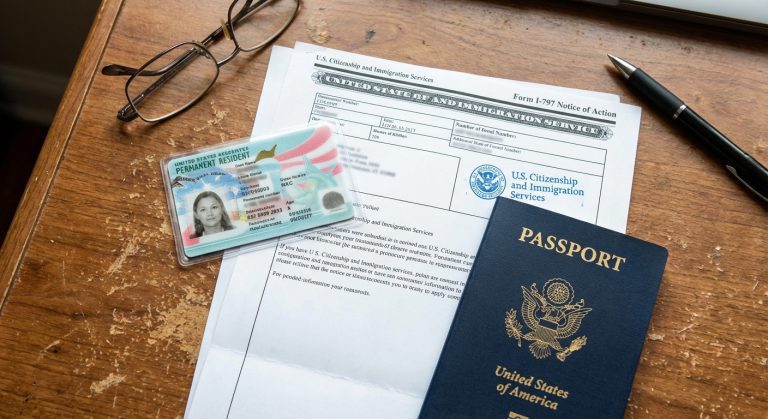
Once you file, USCIS issues Form I-797, a receipt notice that serves as legal proof of your continuing status while your new card is produced. Border agents accept this receipt together with your expired card, the exact combination you need when traveling with an expired green card and Form I-797.
What you can do while waiting:
- Work: Present your I-797 + expired card together for I-9 verification. Employers must accept this combination.
- Travel: Carry both documents at all times. If you no longer have any card, you can request an ADIT stamp by scheduling an appointment through the USCIS Contact Center.
- Stay protected: Your rights as a lawful permanent resident remain in place throughout the wait.
Keep your address updated with USCIS so you receive every case notice during this period.
If you have questions about your specific situation or are unsure which steps apply to you, reach out to our office; we are here to help.
Frequently asked questions about green card renewal
What should I do if I missed the window for renewing a permanent resident card?
File as soon as possible. Your legal status as a permanent resident generally remains valid even after the card expires, but you lack the physical proof needed for employment and re-entry.
USCIS allows late filings. Once accepted, your receipt notice extends your status for 36 months from your card’s printed expiration date. Keep a copy of your expired card alongside your new filing evidence to demonstrate continuous lawful presence.
How does the government determine if I need a new biometrics appointment?
USCIS evaluates whether your previously captured fingerprints and photographs can be reused. If your biometric data is outdated or insufficient, you will receive an appointment notice for an Application Support Center. Attending is mandatory.
If USCIS decides to reuse your existing data, they will simply notify you, since biometric services are already included in your filing fee either way.
Is it possible to travel outside the United States while the renewal application is pending?
Yes. Travel is permitted, but you must carry both your expired card and your Form I-797 receipt notice. Border Protection officers will ask for both documents at re-entry.
If your receipt has not arrived or is insufficient for urgent travel, an ADIT stamp in your passport provides reliable temporary proof of your permanent resident status.
What factors might lead to a denial of an I-90 application?
Common reasons for rejection include using the wrong form, missing signatures, or an incorrect fee. Filing significantly earlier than the six-month window, without a valid reason, can also delay or complicate your case.
Cases where USCIS discovers abandoned resident status or certain types of criminal history may face closer scrutiny during the review process.
How can I update my information if I move after starting the renewal process?
You are legally required to notify USCIS within ten days of moving. File Form AR-11 online to update your address. This ensures your new card reaches the correct location and that you receive any Requests for Evidence.
Do not rely on mail forwarding for government documents; it is often insufficient and can cause you to miss critical notices.