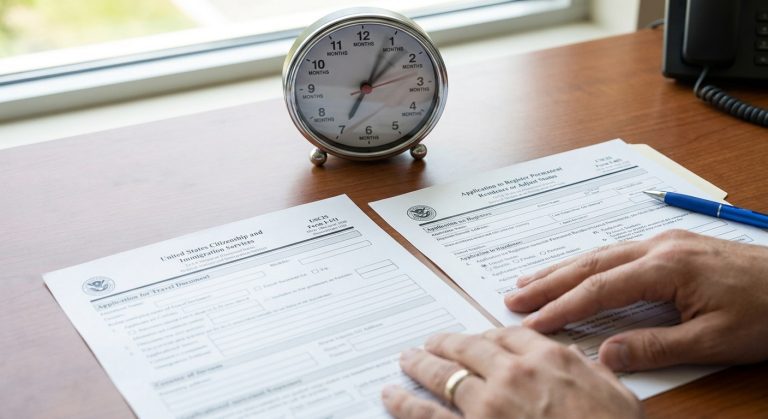
For applicants with a pending green card case, the best official benchmark for advance parole processing time is a national median of 7.7 months in fiscal year 2026 through June 30. Your case can be shorter or longer.
Waiting for approval before you depart the U.S. is important, since traveling too soon can mean abandoning your adjustment of status application. Our green card attorneys can help explain these immigration rules and protect your path to a green card.
Current advance parole processing time
USCIS reports a 7.7-month national median for Advance Parole Documents in fiscal year 2026 through June 30. This advance parole processing time median describes completed cases across USCIS offices, not a promise for your application.

Why advance parole matters to a pending green card application
Advance parole is a USCIS travel document that allows certain applicants to travel and ask to be paroled into the U.S. without USCIS treating the trip as abandonment of a pending Form I-485. It does not guarantee parole at the port of entry.
Leaving while Form I-485 is pending can cause USCIS to deny the application as abandoned unless you obtain advance parole before departure or qualify for a specific exception.
Exceptions for certain nonimmigrant statuses
USCIS instructions describe exceptions for applicants who maintain lawful H, L, V, or K-3/K-4 nonimmigrant status and return with a valid visa in that category.
These exceptions have conditions and do not remove other travel risks. Our adjustment of status after marriage clients often ask us to review their status and documents before booking travel.
How to use the USCIS timing data
The national median is a useful planning benchmark, but the estimate for your filing can change with USCIS workload, staffing, policy changes, requests for evidence, and the details of your case.
Check the current estimate for Form I-131
Use your receipt notice and filing category in the USCIS processing times tool. Compare that current result with the 7.7-month fiscal year 2026 national median, then plan around the case-specific estimate rather than treating either figure as a guaranteed decision date.
Form I-131 is used to request advance parole. Eligible applicants may file it with Form I-485 or while Form I-485 is pending. Filing options and fees depend on the request category, so use the current USCIS form instructions and fee schedule.
USCIS updates its public processing data regularly. For the most current estimate, check the official USCIS processing times tool at egov.uscis.gov/processing-times and select Form I-131. Review current filing instructions at uscis.gov/i-131.
Factors influencing processing delays
Several elements contribute to the variability in advance parole processing time. These include the overall application volumes USCIS is managing, the current workload at specific service centers, and the individual complexity of each case. For example, if your application requires additional evidence or has discrepancies, it can lead to delays as USCIS requests more information.
Use the details on your receipt notice

The USCIS tool asks for the form, filing category, and processing location when applicable. Use the details on your receipt notice so you do not compare your case with the wrong category.
General medians provide context, while your receipt number and the current USCIS tools provide the most relevant information for tracking your filing.
Tracking your advance parole application and expedite options
Your receipt number lets you track case updates, while expedite and emergency advance parole requests address different levels of urgent travel need.
Checking your application status online
Applicants can check USCIS case status updates online using the USCIS online case status tool and their receipt number. For a timing estimate, use the separate processing-times page and choose the form details shown on your receipt notice.
While these tools provide helpful updates, posted processing times are estimates and do not guarantee a specific approval date for your advance parole.
Expedite requests for urgent cases
USCIS may expedite Form I-131 when an applicant shows a pressing or critical need to leave the U.S. The need may involve a planned or unplanned event.
USCIS decides expedite requests case by case and generally requires supporting documentation. Approval of the request is discretionary, so do not make travel commitments based on an assumed outcome.
The emergency advance parole process
If you have an immediate and urgent need to travel, you may request an emergency advance parole appointment. USCIS does not promise a standard turnaround, and you must be ready to document the emergency.
You can use the official USCIS appointment request service or contact USCIS if the online tools do not address your need. Follow the current instructions for any form, evidence, fee, or identity document required for the appointment.
Advance parole versus a re-entry permit
Immigration travel documents can be confusing. Advance parole is often mistaken for other forms of travel authorization, but knowing their distinct purposes and eligibility helps you apply for the correct document.
If columns extend beyond the view, swipe the table horizontally or focus it and use the arrow keys.
| Feature | Advance Parole | Re-Entry Permit |
|---|---|---|
| Purpose | Allows certain applicants with a pending case, including many Form I-485 applicants, to travel and seek parole on return. When the applicable conditions are met, it can prevent USCIS from treating the pending application as abandoned. | For lawful permanent residents (green card holders) who plan an extended stay outside the U.S. and want a travel document that supports their intent to maintain permanent residence. |
| Who Needs It | Many applicants with a pending Form I-485 who do not qualify for one of the nonimmigrant travel exceptions explained above. Advance parole also has uses outside this article’s adjustment focus. | Lawful Permanent Residents (LPRs) who already have a green card and expect to be abroad for an extended period. |
| Appearance | Typically a single-page document or a “combo card” (combining Advance Parole with an Employment Authorization Document, EAD). | Looks like a U.S. passport (a bound booklet). |
| Validity | Use the expiration date and entry terms shown on the document USCIS issued. | Use the expiration date and travel conditions shown on the permit USCIS issued. |
The key distinction is your current immigration status and the purpose of the trip. Advance parole may protect a pending Form I-485 from abandonment, but it does not guarantee parole after inspection.
In contrast, lawful permanent residents planning an extended stay abroad should account for the reentry permit processing time before departure. A re-entry permit serves a different applicant and purpose than advance parole.
Risks of traveling with advance parole while your green card is pending
While advance parole provides authorization to travel, it does not eliminate all potential risks associated with international travel while your green card application is pending. Preparing for these possibilities helps you protect your application.
Admission is not guaranteed
An approved advance parole document lets you appear at a U.S. port of entry and request parole, but it does not guarantee that CBP will parole you into the country. You remain subject to inspection and a discretionary decision.
Inadmissibility risks
Issues such as past immigration violations, certain criminal records, or other inadmissibility grounds can lead to denial of re-entry, even if you possess advance parole.
If you have previous visa overstays, arrests, removal proceedings, or another complicated immigration history, review the effect of travel before departing. Advance parole does not resolve inadmissibility or every abandonment issue, and the consequences depend on your record.
Our team can review the travel document, pending application, and immigration history together before you decide whether to leave the U.S.
A delayed Form I-485 can extend the period when international travel needs careful planning. Review how green card delays affect the broader case instead of assuming advance parole will resolve the underlying wait.

Preparing for re-entry
Carry the travel document USCIS issued, your passport, and relevant case records, including a copy of the I-485 application or receipt notice. CBP may refer a traveler for additional inspection.
Carry authentic documents and answer questions completely and truthfully.
If you are unsure about the specific advance parole processing time for your application, whether your travel plans align with your pending green card, or the potential risks at the port of entry in your case, reach out and our team will look at it with you.
Frequently asked questions about advance parole processing time
What are the real risks of international travel while my green card application is pending, even with advance parole?
Even with advance parole, U.S. admission is not guaranteed. Customs and Border Protection (CBP) officers at the port of entry retain discretion to deny entry, especially if you have past immigration violations or certain criminal records. Reviewing your specific history with our attorneys before departure helps protect your pending application.
How do I know if my H-1B or L-1 visa allows me to travel internationally without advance parole?
The H-1B and L-1 visa exception is fact-specific. USCIS instructions say it may apply when a traveler remains in lawful H or L classification and comes back using the corresponding valid visa. Our team can review whether you meet the conditions before travel.
What specific situations qualify for an emergency advance parole request?
Emergency advance parole may be available when travel is immediate or extremely urgent. USCIS decides each request case by case and generally requires supporting evidence. Severe illness, a death in the family, or an urgent medical need are examples, not a closed list, and a planned event is not automatically excluded.
What happens if my green card application is approved while I am traveling abroad with advance parole?
If USCIS approves your Form I-485 while you are abroad, contact USCIS, CBP, and your immigration attorney before returning to confirm which documents and inspection process apply. Do not assume the advance parole document guarantees parole or admission after the case is no longer pending.
How far in advance should I apply for advance parole before my intended travel date?
For fiscal year 2026 through June 30, the official national median was 7.7 months. Apply as early as your circumstances allow, then check the current USCIS data for your filing category.
Can my advance parole document be renewed if it’s nearing expiration?
You may request a new advance parole document by filing Form I-131. Check the current form instructions, fee rules, and processing estimate before your existing document expires, and do not assume a pending request extends the document you already have.