6 min read
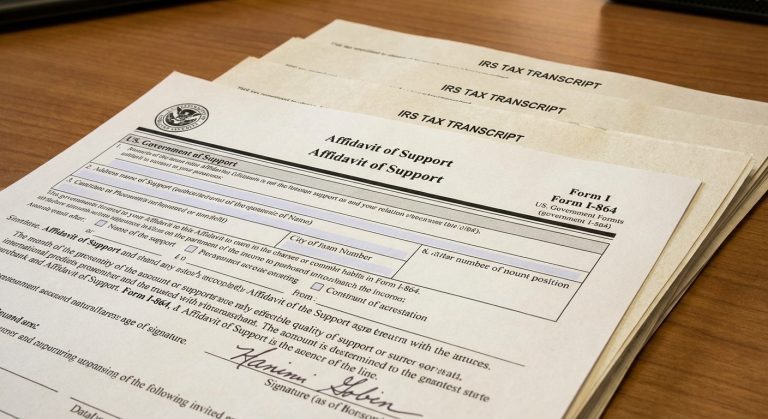
The affidavit of support is more than a form — it is a legally binding contract between a sponsor and the U.S. government guaranteeing that an intending immigrant will not rely on government assistance programs.
The financial scrutiny involved can affect the outcome of a green card application. A family-based immigration attorney can confirm whether your income meets federal standards before you file.

Who is required to file an Affidavit of Support?
Form I-864 is mandatory for most family-based immigrants. Immediate relatives of U.S. citizens — spouses, unmarried children under 21, and parents of adult citizens — must have a sponsor. Without this document, the visa application cannot move forward.
For those pursuing residency through marriage-based immigration, the petitioning spouse must file Form I-864 as part of the process. Family preference categories — adult children of citizens, siblings — also require sponsorship.
In employment-based cases, the form applies when a relative holds 5% or more ownership in the petitioning business. Identifying your specific category early helps you prepare the correct documentation from the start.
Understanding the financial requirements for a sponsor
Most sponsors must show annual income of at least 125% of the current HHS Poverty Guidelines. This ensures they can support both their existing household and the intending immigrant without relying on public assistance.
One exception: active-duty U.S. Armed Forces members sponsoring a spouse or child only need to meet the 100% threshold, in recognition of their service.
Household size directly determines the required income level. The count includes the sponsor, any tax dependents, and the intending immigrant. Because guidelines change annually, always verify current figures with the Department of Health and Human Services.
The legal obligations and risks of signing Form I-864
Signing Form I-864 creates a legal obligation enforceable in court. If the immigrant receives means-tested public benefits, the sponsor can be required to reimburse the government — regardless of personal circumstances like divorce.
The obligation ends only when one of these five conditions is met:
- The immigrant becomes a U.S. citizen through naturalization
- The immigrant completes 40 qualifying quarters of work
- The sponsor or immigrant dies
- The immigrant permanently departs the United States
- The immigrant loses lawful permanent resident status and leaves the country

What happens if the petitioner’s income is not enough?
Falling short of the 125% threshold does not necessarily block the sponsorship. Three options are available:
- Joint sponsor: Any U.S. citizen or lawful permanent resident who independently meets the income threshold for their own household can co-sign Form I-864.
- Household member income (Form I-864A): A working adult in the same home can combine their income with the petitioner’s by signing a separate form.
- Assets: Savings, stocks, bonds, or real estate equity that can be converted to cash within one year — the value must be several times the income gap.

Exemptions and when Form I-864 is not required
Some immigrants qualify for an exemption from the standard affidavit requirement:
- Those who have earned — or can be credited with — 40 qualifying quarters of U.S. work history
- Children of U.S. citizens who acquire citizenship automatically upon admission under the Child Citizenship Act
Immigrants in exempt categories must still file Form I-864W to notify USCIS and document the legal basis for the exemption. This step is required even when the standard financial sponsorship does not apply.
Essential evidence to include with your Affidavit of Support
USCIS requires specific documentation to verify sponsor income. Key evidence to include:
- Tax history: Most recent federal tax returns with all W-2s or 1099s. IRS tax transcripts are preferred for their clarity.
- Current employment: Recent pay stubs from the last six months or a formal employment letter on company letterhead.
- Legal status: Birth certificate, U.S. passport, or valid Permanent Resident Card.
Self-employed sponsors should also include Schedule C, a year-to-date profit and loss statement, or recent business bank statements to demonstrate income consistency.
If you have questions about your specific case or are not sure whether your financial situation qualifies, reach out to our office — we are here to help.
FAQs about Form I-864 income and sponsorship
Does a joint sponsor have to be a family member of the intending immigrant?
No. Any U.S. citizen or Lawful Permanent Resident who is at least 18 years old and living in the United States can serve as a joint sponsor — regardless of their relationship to the petitioner or immigrant.
The joint sponsor must independently meet the 125% income threshold for their own household size plus the intending immigrant. This allows applicants to seek help from close friends or extended family members if the primary petitioner falls short.
Can I act as a financial sponsor if I am currently retired or unemployed?
Yes. Being retired or unemployed does not automatically disqualify you, provided you meet the income requirements through other means. USCIS considers Social Security benefits, pensions, interest, and dividends — as long as they are reported on your federal tax returns.
If your total passive income falls below the poverty guidelines, you may need to use personal assets or secure a joint sponsor to satisfy the form’s requirements and avoid a denial based on the public charge rule.
How are dependents handled when calculating the household size for sponsorship?
The sponsor must include everyone claimed as a dependent on their most recent federal tax return — even those who do not live in the same home. This count also includes the sponsor themselves, any household members who signed a Form I-864A, and the intending immigrant.
Accurately reflecting this number is vital because a higher household count increases the minimum income threshold you must prove for the affidavit to be accepted.
Does filing for bankruptcy terminate the legal obligations of a financial sponsor?
Generally, no. The support obligations established by the Affidavit of Support typically remain enforceable despite a bankruptcy discharge. This document is considered a contract with the U.S. government, not a consumer debt.
The legal responsibility persists until one of the five statutory conditions — such as the immigrant’s naturalization or the completion of 40 work quarters — is officially met.
What specific evidence should self-employed sponsors provide to prove their income?
Self-employed sponsors face higher scrutiny because income can fluctuate. In addition to the required federal tax transcripts, include all Schedules from the most recent return — particularly Schedule C for business owners.
A year-to-date profit and loss statement or recent business bank statements can also help demonstrate a consistent income stream and give the reviewing officer a clearer picture of your financial stability.