5 minutes of estimated reading time
Entering the USCIS field office is the final hurdle in the naturalization journey, requiring applicants to demonstrate their knowledge and eligibility. Understanding the specific citizenship interview questions beforehand transforms a stressful encounter into a predictable conversation with a government official. This evaluation is not designed to trick you but to confirm that the information provided in your application remains accurate and truthful today.
Preparation involves more than memorizing historical dates; it requires a clear understanding of your own immigration history and the ability to communicate in basic English. Working with a citizenship attorney can help you identify potential red flags in your personal record that might arise during the verbal examination. These professionals often conduct mock sessions to ensure you feel confident when answering the officer’s inquiries.

The three core categories of citizenship interview questions
The naturalization process is structured into three distinct segments to evaluate your readiness for United States citizenship. From the moment the officer greets you in the waiting room, they are already assessing your English proficiency through casual conversation and your ability to follow simple instructions.
Most interviews are relatively brief, typically lasting between 15 and 30 minutes, though how long naturalization takes overall depends on factors like your field office’s processing schedule and the complexity of your application.
During this window, the officer focuses on the civics test, the English language assessment, and a comprehensive review of your N-400 application. Using specific citizenship interview questions, the official verifies that you meet the residency requirements and possess the good moral character necessary for naturalization. Each segment serves a different purpose, ensuring you are both linguistically capable and civically informed.
Mastering the civics and history portion
The civics component is often the most anticipated part of the day, as it tests your knowledge of U.S. government and history. You will be asked up to 10 questions from a standard pool of 100 possible items, and you must answer at least 6 correctly to pass.
Once you reach the six-correct-answer threshold, the officer will usually stop that portion of the test and move forward. It is vital to use official USCIS study materials rather than third-party apps to ensure you are learning the most current and accepted answers.
Certain applicants may qualify for exemptions under the 65/20 rule, which allows older individuals with long-term permanent residency to take a simplified version of the test. Consulting with naturalization attorneys can clarify whether you qualify for this exemption and what reduced test version applies to your case.
Understanding the N-400 personal history review
Reviewing your N-400 application is a fundamental part of the process where the officer asks you to verify your personal details aloud. This includes confirming your travel history, employment record, and marital status to ensure there are no discrepancies between your written testimony and your verbal responses.
These citizenship interview questions are designed to confirm that you have maintained continuous residence and physical presence in the United States. A significant portion of this review focuses on the “Have you ever” questions, which cover legal history, organizational memberships, and tax compliance.
You must remain honest even if certain circumstances have changed since you first filed the paperwork, such as a new job or a recent trip abroad. Providing truthful updates during the interview demonstrates your integrity and prevents potential accusations of misrepresentation.

Essential documents to bring to your appointment
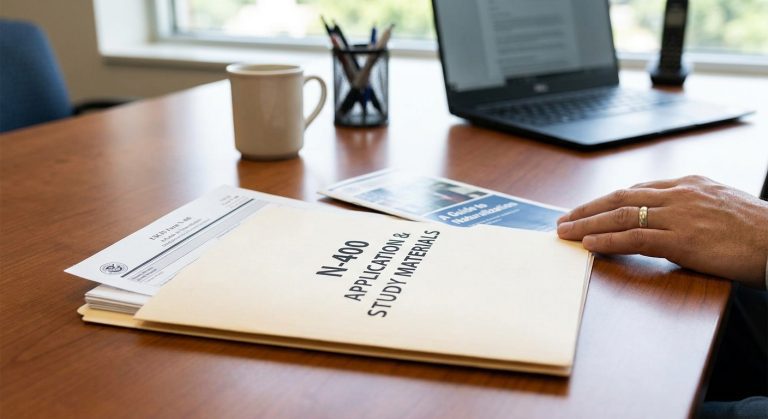
Being organized with your physical documentation is a practical way to show the officer that you are prepared and professional. Having your papers neatly arranged in a folder allows you to retrieve requested evidence quickly, which can help the interview proceed smoothly. You should always bring the original versions of documents you submitted with your application, along with your current identification.
- Official Notice: You must present the original Form I-797, Notice of Action, which serves as your official appointment letter for the interview.
- Identification Cards: Bring your permanent resident card and a valid state-issued driver’s license or identification card to verify your identity.
- Travel Documents: Present all current and expired passports used during your time as a permanent resident to corroborate your reported international travel history.
- Supporting Evidence: Carry secondary documents such as certified marriage certificates, tax transcripts, or court records if your specific case requires them.
Organizing these items chronologically can reduce your anxiety and demonstrate your readiness for the responsibilities of citizenship. If you are still in the earlier stages of your case, how to begin the naturalization process provides a step-by-step guide from the N-400 filing onward.

How to handle nerves and clarifying questions
It is perfectly normal to feel nervous during a government interview, and most USCIS officers are accustomed to seeing anxious applicants. If you do not understand a question because of the officer’s speed or accent, you are allowed to politely ask for clarification.
Asking the official to repeat or rephrase a sentence is a standard part of communication and does not count against your English proficiency. Listening carefully to the entire question before starting your response is the best strategy to avoid providing irrelevant information.
If you do not pass a certain portion of the interview on your first attempt, do not panic. USCIS will typically schedule a second appointment to retest you on the section you missed. For context on broader outcomes, what happens if your citizenship application is denied explains how a denial can affect your current immigration status.
Wait times and the path to the oath ceremony
At the conclusion of your interview, the officer will provide you with Form N-652, which outlines the results of your examination. This document will indicate if your application was recommended for approval, if a decision cannot be made yet, or if the case was denied.
If additional evidence is required, you will receive a specific notice detailing exactly what information you need to submit.
Once approved, you will wait for a notice regarding your naturalization ceremony, where you will take the official Oath of Allegiance. This final step marks the formal transition from a permanent resident to a United States citizen with full legal rights. Working with a citizenship attorney can ensure that this final phase is reached without unnecessary delays or procedural errors.
FAQs about naturalization interview preparation and civics testing
What happens if I discover an error on my application during the citizenship interview questions?
If you identify a mistake on your N-400 while speaking with the officer, it is essential to disclose it immediately. The officer typically reviews the form line-by-line, providing a natural opportunity to offer corrections.
Admitting a clerical error or a forgotten detail demonstrates your commitment to transparency. While minor corrections are common, significant changes regarding your legal history or residency should be discussed with a legal professional beforehand to understand how they might impact your eligibility.
How is the reading and writing section of the English proficiency test conducted?
For the reading portion, the USCIS officer will ask you to read one of three sentences aloud on a tablet or piece of paper to demonstrate your basic comprehension. To pass the writing section, you must write one out of three sentences correctly as dictated by the official.
These sentences focus on civil and historical themes. The officer is looking for your ability to communicate simple ideas rather than perfect grammar or spelling, as long as the meaning of the sentence remains clear and understandable.
Is it possible to have a legal representative present during the naturalization examination?
Yes, you have the right to be accompanied by a qualified legal representative, such as an attorney or an accredited representative. Your lawyer can sit in on the interview to ensure that the officer follows proper procedures and to help clarify legal points if a complex issue arises.
However, the attorney cannot answer the civics or English questions for you. Their role is to observe and protect your rights, providing a sense of security for applicants who may feel overwhelmed by the formal environment of the field office.
What should I do if I do not know the answer to a specific civics question?
If you are asked a civics question and cannot recall the answer, it is best to remain calm and be honest. Since you only need to answer six out of ten questions correctly, missing one does not mean you have failed the entire test.
You can simply inform the officer that you do not remember that specific fact. They will then move on to the next question in the pool. Trying to guess wildly or becoming visibly distressed may affect your focus on the subsequent, potentially easier questions.
Can changes in my life, like a new child or job, be updated during the interview?
Absolutely. Life events often occur during the months spent waiting for an interview notice. You should bring supporting documentation, such as a birth certificate for a new child or proof of new employment, to your appointment.
When the officer reviews the corresponding sections of your N-400, you can provide these updates verbally. Keeping your record current ensures that your file is accurate at the time you take the oath. Being proactive about these changes shows the officer that you take the naturalization process seriously.