After USCIS approves the petition, the next step after I-130 approval depends on whether the spouse will apply inside or outside the United States, whether adjustment is legally available, and whether an immigrant visa number is available.
Approval establishes the qualifying relationship for the petition. It does not, by itself, grant permanent resident status, permission to work, or permission to travel.
Choose the correct next step after I-130 approval
The first decision is not simply where the spouse lives. It is whether the spouse is eligible to file Form I-485 with USCIS or must complete immigrant visa processing through the National Visa Center and a U.S. consulate.
If columns extend beyond the view, swipe the table horizontally or focus it and use the arrow keys.
| Situation | Likely next step | What to confirm first |
|---|---|---|
| Spouse is in the United States and appears eligible to adjust status | Prepare Form I-485 and the supporting packet for USCIS | Entry or parole history, visa availability, adjustment bars, inadmissibility, and USCIS jurisdiction |
| Spouse will apply from outside the United States | Follow NVC instructions, then complete the consular interview process | Case transfer, priority date if applicable, fees, financial evidence, civil documents, and interview post |
| Spouse is in the United States but may not qualify to adjust | Get case-specific advice before filing or departing | Unlawful entry, prior violations, removal proceedings, inadmissibility, waivers, and departure consequences |
Our detailed guides explain adjustment of status after marriage and the consular processing timeline. Neither route should be selected from physical location alone.

Understand what the approval actually decides
USCIS approval means the agency accepted the family relationship supporting Form I-130. The official Form I-130 instructions make clear that approval does not automatically make the beneficiary a lawful permanent resident or allow immediate immigration.
The spouse still must qualify for adjustment of status or an immigrant visa. USCIS or a consular officer will separately evaluate eligibility, admissibility, required evidence, and any issue specific to the case.
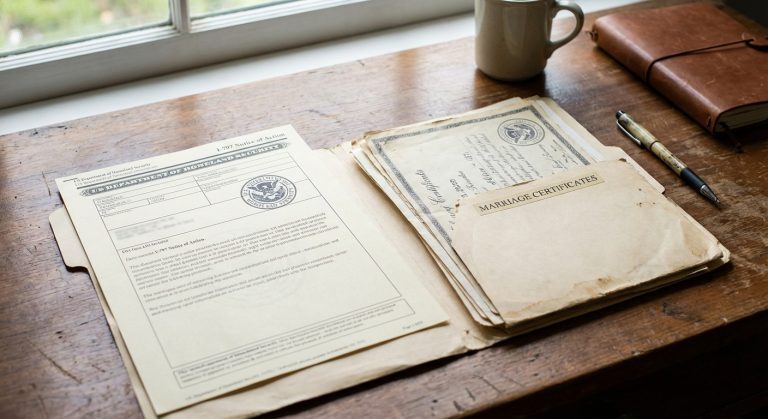
The approval notice also identifies where USCIS intended to send the case. Read it carefully. A notice directing a consular case to NVC does not itself require an eligible adjustment applicant to leave, but correcting the processing path may require additional steps.
A routing mismatch does not decide substantive eligibility. If the notice names NVC but the spouse is eligible to adjust, the next step after I-130 approval may be filing Form I-485 with a copy of Form I-797. NVC does not adjudicate adjustment applications, and every filing must still satisfy the applicable eligibility and visa availability rules.
Check whether an immigrant visa is available
A spouse of a U.S. citizen is an immediate relative, so an immigrant visa number is not subject to the family preference limits. A spouse of a lawful permanent resident is generally in the F2A preference category and must account for visa availability.
For F2A cases, compare the priority date on the approval notice with the monthly family-based Visa Bulletin. Adjustment applicants must also use the chart that USCIS designates for that month, not assume that the more favorable chart controls.
As of September 2026, DOS lists F2A Dates for Filing as current. USCIS directs family-sponsored adjustment applicants to use the Dates for Filing chart that month. Final Action still limits when USCIS may approve the case: August 22, 2026 for most chargeability areas and August 22, 2025 for Mexico.
Those dates can advance, stop, or retrogress. Confirm the current official Visa Bulletin immediately before submitting an application or relying on a visa number for final action.
For an F2A case, the chart that permits document submission is not necessarily the chart that permits final approval. A current Dates for Filing row can allow pre-processing while Final Action remains cut off. Check the priority date, country of chargeability, processing route, and USCIS monthly chart selection together before filing or expecting a decision.
File Form I-485 only if adjustment is available
Being inside the United States does not automatically create eligibility for adjustment. Under the general rule, the applicant must have been inspected and admitted or paroled, have an immigrant visa immediately available, and remain eligible despite adjustment bars and grounds of inadmissibility.
Some immediate relatives have exceptions to certain adjustment bars, but those exceptions do not cure every issue. Entry without inspection, prior removal orders, misrepresentation, criminal history, or unlawful presence can change the analysis and may affect whether departure is safe.
An eligible spouse filing after petition approval generally submits Form I-485 with a copy of the I-130 approval notice and the evidence required by the current Form I-485 instructions. Our Form I-485 guide explains the application itself.
Employment authorization and travel permission are separate benefits. Filing or receiving approval of Form I-130 does not authorize either one. A pending adjustment applicant should obtain advice before travel because departure can abandon Form I-485 or trigger other immigration consequences, even when advance parole is available.
Complete NVC processing for the consular route
For a consular case, USCIS sends the approved petition to NVC. The Department of State explains that NVC requests the immigrant visa fee and documents, then holds the case until an interview can be scheduled at a U.S. embassy or consulate.
After the Welcome Letter arrives and the case is eligible to proceed, the parties generally use CEAC to pay the required fees, complete Form DS-260, submit the Affidavit of Support and financial evidence, and upload the required civil documents.
The petitioner normally must submit Form I-864 even when a joint sponsor is needed. Our Affidavit of Support guide covers that obligation and why a joint sponsor does not replace the petitioner’s form.
NVC’s documentarily complete status means the submitted materials passed its pre-processing review. It is not a visa approval. Interview timing still depends on visa availability when required, the embassy’s capacity, and completion of the remaining steps.

Prepare documents and the medical exam at the right time
Both routes require evidence tailored to the application. Common items include identity and civil records, the approval notice, financial sponsorship materials, and updated evidence that the marriage remains genuine. The exact list differs between USCIS and the designated consular post.
Consular applicants follow NVC and embassy instructions for civil documents, translations, originals, and the medical examination by an authorized panel physician. Adjustment applicants follow USCIS instructions, including the current requirements for Form I-693 and an examination by a designated civil surgeon.
Do not schedule a medical examination solely because the I-130 was approved. The correct timing depends on the route and current agency instructions. For broader eligibility context, review the marriage Green Card requirements.

Avoid mistakes that can change the route
- Do not file Form I-485 based only on presence in the country. Confirm admission or parole, visa availability, bars, admissibility, and jurisdiction.
- Do not treat NVC contact as a visa approval. NVC handles pre-processing, while the consular officer decides the visa application.
- Do not use an old Visa Bulletin. F2A dates and the chart selected by USCIS can change monthly.
- Do not travel based on I-130 approval. The petition provides no travel document and departure may create serious consequences.
- Do not ignore a routing mismatch. If the approval notice sends the case to the wrong destination, address it before assuming either agency will transfer the file automatically.
Get help choosing the next step after I-130 approval
The safest next step after I-130 approval is the one supported by the spouse’s full immigration history, the petitioner’s status, the approval notice, and current visa availability. A wrong filing or an avoidable departure can create delay, expense, or legal risk.
If those facts do not point clearly to adjustment or consular processing, our Houston immigration team can review the case and explain the available family-based Green Card path. We do not promise approval, timing, or a result.
FAQs about the next step after I-130 approval
Can I choose between adjustment of status and consular processing if I am already in the U.S.?
Not always. Physical presence is only one fact. Adjustment generally requires an eligible entry or parole, visa availability, admissibility, and freedom from applicable bars. Some people in the United States must use consular processing, while departure may create separate risks that should be reviewed first.
Is it safe to travel outside the United States once my I-130 petition is approved?
I-130 approval does not authorize travel or guarantee readmission. A person with a pending Form I-485 may abandon the application by leaving without the required travel document, subject to limited exceptions. Unlawful presence, prior orders, and other history can create additional consequences.
What does it mean if my I-130 approval notice says the petition was sent to the NVC, but I am living in the U.S.?
It means USCIS routed the approved petition for consular processing. If the beneficiary is independently eligible to adjust status, living in the United States does not necessarily require departure. Review the notice and eligibility before filing because moving a case between processes can require agency coordination.
How do I know when to start the next phase if I am the spouse of a lawful permanent resident?
Find the priority date on the approval notice, check the current F2A row in the Department of State Visa Bulletin, and use the filing chart selected by USCIS if seeking adjustment. NVC may begin pre-processing before final action is available, but a visa cannot be issued until permitted.
Should I complete my immigration medical exam immediately after receiving the I-130 approval notice?
Not solely because the petition was approved. Adjustment applicants should follow the current Form I-693 instructions. Consular applicants should follow the appointment and medical instructions for their embassy or consulate. Completing the wrong exam or using the wrong physician can waste time and money.
Does the approval of my spouse’s petition automatically include our children?
Not in every category. A U.S. citizen generally files a separate Form I-130 for each immediate relative because that category does not allow derivative beneficiaries. F2A cases may allow eligible derivative children, but age, marital status, and Child Status Protection Act issues require individual review.