Estimated reading time: 6-8 minutes
If you are asking what is I-360 form, you are likely trying to understand how certain humanitarian immigration petitions work in the United States. Form I-360, officially known as the Petition for Amerasian, Widow(er), or Special Immigrant, is used in several immigration categories, including cases involving victims of abuse, crime, or human trafficking. Its role varies depending on the type of protection being requested.
In cases involving abuse under the Violence Against Women Act, working with a qualified VAWA immigration attorney can help clarify how Form I-360 functions as a self-petition and what evidence is required. Because this form operates differently in VAWA, U Visa, and T Visa cases, understanding its specific purpose in each category is essential before filing.

What Form I-360 Is and What It Does?
Form I-360 is a petition filed with U.S. Citizenship and Immigration Services (USCIS) to request classification under specific humanitarian or special immigrant categories. Unlike many immigration petitions that must be filed by a sponsor, Form I-360 can function as a self-petition in certain cases, meaning the applicant files on their own behalf. In humanitarian contexts, the I-360 is most commonly associated with:
- VAWA self-petitions for victims of domestic abuse
- Certain special immigrant categories
- Adjustment pathways for U and T visa holders in specific circumstances
The purpose of the form is to establish eligibility under a protected immigration category. Approval of Form I-360 does not automatically grant permanent residence. Instead, it classifies the applicant under a qualifying category, which may later allow them to apply for adjustment of status (Form I-485) if all requirements are met.
How Form I-360 functions depends entirely on the immigration path being pursued. In some cases, it is the core petition establishing eligibility (such as VAWA). In others, it plays a role later in the process, such as when certain U or T visa holders seek permanent residence.

How Form I-360 Works in VAWA Cases?
In VAWA cases, Form I-360 functions as a self-petition for victims of abuse. Under the Violence Against Women Act (VAWA), certain spouses, children, and in some cases parents of U.S. citizens or lawful permanent residents may file Form I-360 independently, without the participation or consent of the abusive family member. In this context, the I-360 petition allows the victim to request immigration classification based on:
- A qualifying family relationship (spouse, child, or parent in certain cases)
- Proof that the relationship was entered in good faith (for marriage cases)
- Evidence of battery or extreme cruelty
- Evidence of shared residence
- Good moral character
Once USCIS approves the I-360 under VAWA, the applicant may become eligible to apply for lawful permanent residence through adjustment of status (Form I-485), depending on visa availability and eligibility.
In VAWA cases, Form I-360 is the foundation of the process. It establishes independent eligibility for immigration protection and removes the abusive sponsor from the petitioning role. Approval does not immediately grant a green card, but it opens the pathway to apply for permanent residence.
How Form I-360 Works in U Visa Cases?
Form I-360 does not initiate a U Visa case. Instead, the U Visa process begins with Form I-918, Petition for U Nonimmigrant Status. However, Form I-360 becomes relevant later in certain U Visa adjustment scenarios. Our U visa petition attorneys can tell you which form your case actually needs before you file anything.
After a U Visa holder maintains lawful status for at least three continuous years and meets cooperation requirements, they may apply for adjustment of status to lawful permanent residence. In some adjustment contexts, Form I-360 may be used to classify certain derivative family members or in special immigrant-related circumstances tied to humanitarian protections.
The key distinction is that, in U Visa cases, the I-360 petition is not the primary filing. Instead, it may serve a secondary role depending on the applicant’s category and immigration strategy.
For U Visa holders, the central benefit is that once eligibility requirements are met — including continuous presence and cooperation with law enforcement — they can pursue permanent residence. The I-360, where applicable, functions within that broader adjustment framework rather than as the initial humanitarian petition.
How Form I-360 Works in T Visa Cases?
In T Visa cases, the process begins with Form I-914, which grants T nonimmigrant status to victims of severe forms of human trafficking. Similar to U Visa cases, Form I-360 is not used to obtain initial T status.
However, after maintaining T Visa status for the required period (generally three years or upon completion of the investigation or prosecution), T Visa holders may apply for adjustment of status to lawful permanent residence.
In specific special immigrant classifications connected to humanitarian protections, Form I-360 may be involved depending on the immigration pathway pursued. The role of the I-360 in T Visa contexts is therefore limited and case-specific, unlike in VAWA cases where it is the core petition.
The critical difference is that in VAWA, Form I-360 is the primary self-petition establishing eligibility, while in U and T visa cases, it may appear in certain adjustment or special immigrant classifications rather than serving as the initial protection mechanism.

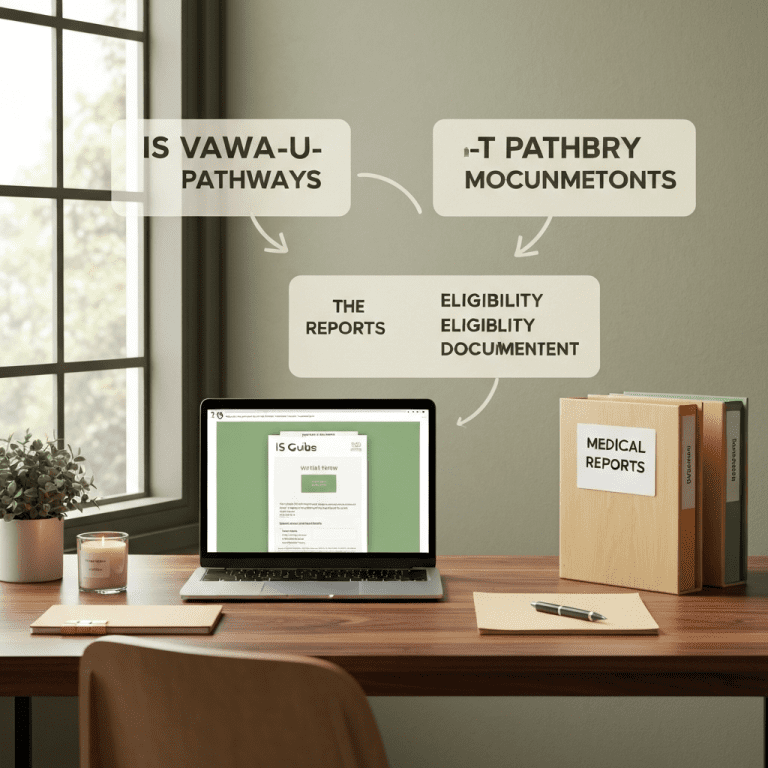
Key Differences Between How Form I-360 Is Used in VAWA, U, and T Cases
Understanding what is I-360 form requires recognizing that it does not function the same way across all humanitarian immigration cases.
In VAWA cases, Form I-360 is the central petition. It allows certain abused spouses, children, or parents of U.S. citizens or lawful permanent residents to self-petition for immigration classification without relying on the abuser. Approval of the I-360 establishes eligibility for adjustment of status.
In contrast, in U Visa cases, the primary petition is Form I-918. The U Visa is granted to victims of qualifying crimes who cooperate with law enforcement. Form I-360 is generally not the initial filing in U cases, though certain derivative or special classifications may involve it depending on the broader immigration strategy.
Similarly, in T Visa cases, the process begins with Form I-914 for victims of severe human trafficking. The I-360 is not the standard petition for obtaining T status. Adjustment of status for T visa holders follows a different procedural path. In simple terms:
- VAWA → I-360 is the foundation.
- U Visa → I-918 is the foundation.
- T Visa → I-914 is the foundation.
This distinction is critical to avoid filing the wrong petition.
What Happens After Form I-360 Is Approved?
If Form I-360 is approved in a VAWA case, the next step typically involves applying for lawful permanent residence through Form I-485, if visa eligibility and admissibility requirements are satisfied. Approval of the I-360:
- Confirms eligibility under a protected category
- Removes the need for sponsorship by the abuser
- May allow access to work authorization
- Opens the path toward permanent residency
However, approval of the I-360 alone does not grant a green card. The applicant must still meet admissibility requirements and complete the adjustment process.
In cases where Form I-360 is connected to other humanitarian classifications, its approval serves as a classification step rather than final immigration status.
When asking what is I-360 form, the answer depends heavily on the context in which it is being used. In VAWA cases, it is a powerful self-petition tool that allows victims of abuse to seek immigration protection independently. In U and T visa contexts, it plays a much more limited and specialized role.
Because humanitarian immigration pathways involve complex eligibility rules and different procedural steps, understanding how Form I-360 applies to your specific case is essential before filing.
Careful evaluation of your category, immigration history, and eligibility requirements can help ensure the correct petition is submitted and reduce the risk of delays or denials.