7 minute read
U Visa eligibility depends on four key criteria: being a victim of a qualifying crime, suffering substantial physical or mental abuse, possessing information about the crime, and cooperating with law enforcement. Our U Visa attorneys help victims assess which criteria apply to their situation.

What crimes qualify for U Visa status?
To qualify for a U Visa, the criminal activity must fall within a defined list of offenses and have occurred in the United States or violated U.S. law. USCIS focuses on crimes that inflict severe harm, recognizing the vulnerability of victims who cooperate with authorities.
The list of qualifying criminal activities is extensive, encompassing violent crimes and those that involve exploitation or abuse. It includes, but is not limited to, the following:
- Abduction
- Abusive sexual contact
- Domestic violence
- Extortion
- False imprisonment
- Felony assault
- Female genital mutilation
- Hostage taking
- Incest
- Involuntary servitude
- Kidnapping
- Manslaughter
- Murder
- Obstruction of justice
- Perjury
- Prostitution
- Rape
- Sexual assault
- Sexual exploitation
- Slave trade
- Stalking
- Torture
- Trafficking
- Unlawful criminal restraint
Applicants frequently underestimate the specific nature of “qualifying criminal activity” required. For instance, while a general assault might be concerning, it must rise to the level of “felony assault” to meet the criteria. The intent behind this specificity is to provide protection to victims of the most severe forms of criminal activity.
Understanding crime categories
The critical aspect of determining a qualifying crime is not just the act itself, but its legal classification and impact.
For example, domestic violence is often a pattern of abusive behavior, but specific incidents within that pattern, such as a felony assault, would be the direct qualifying act. USCIS requires clear evidence linking the victim’s harm to one of these specific criminal activities.
Attempts, conspiracies, and solicitations
Attempts, conspiracies, or solicitations to commit any of these listed crimes also qualify for U Visa status. This means you do not necessarily need to have been fully subjected to the crime to qualify.
If an individual actively plotted, tried, or solicited one of the listed crimes against you, and you suffered harm as a result, that could still establish a qualifying criminal activity for U Visa qualification.
How does USCIS define substantial harm?
To be eligible for a U Visa, you must have suffered “substantial physical or mental abuse” as a direct result of the qualifying criminal activity. This requirement aims to distinguish between minor injuries or fleeting distress and harm that significantly affects a victim’s life.
The term “substantial” means harm that is considerable, serious, or significant, not minor. It can manifest as physical injuries, psychological trauma, or emotional distress. USCIS evaluates both objective evidence of harm and the subjective impact on the victim.
This is not about equating “substantial” with “severe” or requiring permanent disability, but rather about demonstrating a meaningful impact on your physical or mental well-being.
What factors does USCIS consider?
Factors USCIS considers include the nature and severity of the injury, the duration of the abuse, the permanence of the harm, and the extent of intervention or treatment required (e.g., medical care, psychological counseling).
For instance, a broken bone from an assault, lasting nightmares, or a significant change in daily functioning due to anxiety or depression could all contribute to proving substantial harm.
The harm must be directly linked to the qualifying crime, demonstrating a clear causal connection. Our experience helps clarify what types of evidence effectively demonstrate this connection.
Proving mental abuse
Proving substantial mental abuse can be particularly nuanced. It requires more than just a statement of feeling upset; it involves showing how the crime has impacted your psychological state, emotional stability, and ability to function in daily life. This often involves documentation from mental health professionals, detailing diagnoses, treatment, and prognosis.
Without such evidence, USCIS may find it difficult to determine if the abuse meets the substantial threshold. With the crime and harm understood, the critical element of working with authorities comes into play.

What does helpful to law enforcement mean for a U Visa?
To be eligible for a U Visa, you must have been, are being, or are likely to be helpful to a certifying official in the investigation or prosecution of the qualifying criminal activity. This requirement goes beyond simply reporting a crime; it demands active cooperation.
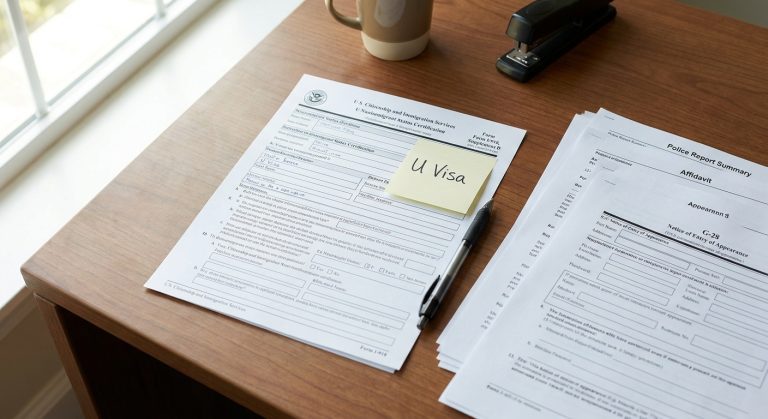
The core evidence for this cooperation is Form I-918, Supplement B, Certification of Helpfulness to Law Enforcement. This form must be completed and signed by an authorized official from a qualifying law enforcement agency, such as the police, sheriff’s office, prosecutor’s office, or even certain federal agencies like the FBI or DHS.
The certification confirms that you have provided information and assistance, and that the crime was one of the specified qualifying criminal activities.
Note that the Form I-918 Supplement B is valid for six months from the date of signature. If more than six months pass between the signing and the filing of your I-918 petition, USCIS may issue a Request for Evidence (RFE) for a new certification, or deny the petition. This emphasizes the need for timely filing.
Scenarios of cooperation
Helpfulness can manifest in various ways and is not limited to securing a conviction. You can meet this requirement even if the perpetrator was never identified, if the investigation is still ongoing, or if the case was closed without charges being filed.
What matters is your willingness and effort to provide useful information. This could include testifying, providing statements, identifying suspects, or assisting in gathering evidence.
Challenging situations for certification
Securing the I-918 Supplement B can be a significant hurdle. Some agencies may be reluctant to sign, or the certifying official might be unfamiliar with the U Visa process. Our firm can assist in communicating with law enforcement agencies to explain the purpose of the certification and facilitate its completion.
Other U Visa eligibility factors and potential inadmissibility
While meeting the victim criteria is paramount, other factors also determine overall U Visa qualification. Beyond demonstrating a qualifying crime, substantial harm, and helpfulness to law enforcement, two additional general requirements must be met: the crime must have occurred in the U.S. or violated U.S. law, and you must be admissible to the United States.
The jurisdictional requirement
The jurisdictional requirement is designed to address crimes that fall under the purview of U.S. legal authority. This means that if the qualifying criminal activity happened entirely outside the U.S. and did not violate a federal law, you would not meet the U Visa qualification criteria.

Understanding inadmissibility and waivers
Furthermore, like most immigration benefits, U Visa applicants must generally be admissible to the United States. Inadmissibility grounds can include prior immigration violations, certain criminal convictions, or past unlawful presence.
However, a significant benefit of the U Visa is that many grounds of inadmissibility can be waived. These waivers allow otherwise inadmissible individuals to receive U Visa status if it is determined to be in the public or national interest.
Legal avenues often exist to overcome these challenges, and our immigration waivers attorneys can assist with the waiver application process.
For those considering a U Visa petition, understanding the bona fide determination process can provide certain benefits while the petition is pending. Similarly, if you are seeking to include family members, you can explore the option for derivative U Visa status for them.
Assessing all eligibility factors, especially potential inadmissibility grounds and the specific process of obtaining waivers, can be challenging. Our experienced immigration attorneys regularly evaluate these broader factors to provide a complete assessment of your U Visa qualification.
If you are unsure about whether the specific criminal activity you experienced qualifies, how to best document the substantial harm you suffered, or what steps to take if law enforcement cooperation is challenging in your situation, contact our team and we will look at it with you.
Frequently asked questions about U Visa eligibility
Does my immigration status affect U Visa eligibility if I was a crime victim?
Your current immigration status generally does not prevent you from being eligible for a U Visa. This status is designed to protect victims of qualifying crimes who cooperate with law enforcement, regardless of whether they are undocumented or hold another visa. USCIS focuses on the crime and your helpfulness.
Is there a time limit to report a crime or apply for a U Visa?
There is generally no strict deadline to file a U Visa petition after a qualifying crime occurs. However, demonstrating helpfulness to law enforcement becomes more challenging over time as evidence may fade. Our team can help assess your specific timeline and options.
What if law enforcement is reluctant to sign my U Visa certification (Form I-918, Supplement B)?
Securing the I-918 Supplement B can be difficult if officials are unfamiliar with the U Visa. Our firm can assist by communicating with law enforcement agencies, explaining the form’s purpose, and facilitating its completion to support your petition.
Can I still qualify for a U Visa if the criminal investigation is closed or no charges were filed?
Yes, you can. Eligibility for a U Visa depends on your helpfulness in the investigation or prosecution, not necessarily a conviction or ongoing case. Providing useful information, even if the case closed without charges or the perpetrator was not identified, can still meet the requirement.
Which family members can be included in my U Visa application as derivatives?
As a principal U Visa applicant, you may be able to include certain family members as derivatives. If you are 21 or older, you may petition for your spouse and unmarried children. If you are under 21, you may also petition for your parents and unmarried siblings under age 18.
In all cases, your petition for U nonimmigrant status must be approved before derivatives can be eligible for their own status.
How can I prove substantial mental abuse if I haven’t seen a mental health professional?
Proving substantial mental abuse typically benefits from professional documentation. If you haven’t received formal treatment, our team can help explore other forms of evidence. This may include sworn affidavits from people who witnessed the impact of the crime on your life, showing significant changes.