8 minute read
Once you file a U Visa, the next question is usually whether your close relatives can also obtain status through your case. U visa derivative status lets qualifying family members, spouses, children, parents (if you are under 21), and certain unmarried siblings under 18, apply for protection based on your principal petition.
Most delays and denials come from who counts as eligible, when the relationship is filed, and how the relationship evidence is presented. Our U Visa attorneys help you identify each qualifying relative, file Form I-918 Supplement A or Form I-929 at the right moment, and prepare the documentation USCIS expects.

Which family members qualify as U visa derivative beneficiaries?
When you, as the principal U visa applicant, seek to protect your family, specific relationship categories are eligible for derivative status. The eligibility for this derivative status depends on your age and the family member’s relationship to you at the time of filing. The key U visa benefits for crime victims extend to qualifying derivatives under specific conditions.
The most common confusion among applicants is assuming all family members qualify without understanding the precise age and relationship requirements. These categories are strictly defined by immigration law, and adhering to them prevents delays:
If columns extend beyond the view, swipe the table horizontally or focus it and use the arrow keys.
| Principal Applicant’s Age | Qualifying Family Members | Relationship Requirement |
|---|---|---|
| 21 years old or older | Spouse, Unmarried Children Under 21 | Must be the principal applicant’s legal spouse or biological/legally adopted unmarried child under 21. |
| Under 21 years old | Spouse, Unmarried Children Under 21, Parents, Unmarried Siblings Under 18 | Parents must be your biological or adoptive parents. Siblings must be unmarried and under 18. |
Each qualifying family member can apply for derivative U nonimmigrant status. You must be able to prove these familial relationships with official documentation, as USCIS thoroughly vets all claims.
What forms do you need to file for your family?
Once you understand who qualifies, the next step involves submitting the correct USCIS forms. The form you use for a qualifying family member depends on whether you are filing simultaneously with your own application or later, after your U visa is approved. You distinguish how you apply for this status based on the timing:
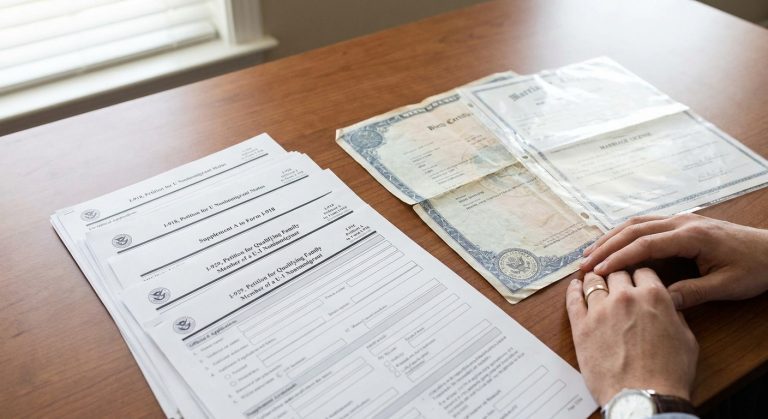
- Filing with your initial U visa petition (Form I-918): If you are applying for your family members at the same time you file your Form I-918, Petition for U Nonimmigrant Status, you must submit a separate Form I-918, Supplement A, Petition for Qualifying Family Member of U-1 Recipient, for each eligible family member.
- Filing after your U visa is approved: If your U visa has already been approved and you later decide to petition for qualifying family members, you will use Form I-929, Petition for Qualifying Family Member of a U-1 Nonimmigrant. This process requires a separate I-929 for each family member.
Always consult the “Where to File” section on the USCIS website for the most current instructions, as filing addresses can change. Incorrectly filed forms can lead to delays or rejections, impacting your family’s immigration journey.

How to show your family relationship to USCIS
Submitting the correct forms is only one part of the process; proving the qualifying family relationships is just as central to a successful outcome. USCIS requires clear and compelling evidence to establish the familial ties between you and each qualifying family member applicant.
Gathering evidence can be straightforward for some, but challenging for others, particularly with non-traditional family structures or if documents are unavailable:
- For spouses: A marriage certificate is typically the primary evidence. You may also need joint financial documents, utility bills, or affidavits from individuals who can attest to the bona fide nature of your marriage.
- For children: Birth certificates listing you as a parent are generally sufficient. For adopted children, official adoption decrees are necessary.
- For parents: Your own birth certificate, listing your parents’ names, serves as the main proof.
- For siblings: Your birth certificate and your sibling’s birth certificate, showing common parent(s), are usually required.
All foreign language documents must be accompanied by a certified English translation. If original documents are lost or unavailable, secondary evidence such as school records, medical records, or sworn affidavits from knowledgeable parties can sometimes be accepted. This often requires additional explanation to USCIS.
What happens if a derivative family member’s status changes?
The U visa process can be lengthy, and during this time, a derivative family member’s eligibility might change. Understanding the implications for a U visa derivative if their relationship status changes can impact their application.
Certain events can significantly impact an application, affecting a derivative’s ability to maintain eligibility during the prolonged waiting period:
If columns extend beyond the view, swipe the table horizontally or focus it and use the arrow keys.
| Status Change | Impact on Derivative Eligibility |
|---|---|
| Child ages out (turns 21) | The Child Status Protection Act (CSPA) may “freeze” the child’s age for immigration purposes if specific conditions are met. However, CSPA rules are complex and do not apply to all derivative applicants. |
| Unmarried child marries | An unmarried child derivative who marries before receiving their U visa will typically lose their eligibility, as their qualifying relationship is severed. |
| Spouse divorces principal | If the principal applicant and spouse divorce before the spouse receives U visa approval, the spouse will likely lose eligibility as a U visa derivative. |
| Death of principal applicant | In some limited circumstances, qualifying family members may continue to be eligible to apply for a U visa even if the principal U-1 nonimmigrant dies. |
These changes require immediate notification to USCIS. Failing to report significant life events can be detrimental to the derivative application. We often see that clients are unaware of these precise requirements, which can impact eligibility if not addressed early in the process.

How long could your family wait for a U visa?
Understanding the timeline for a U visa derivative to receive their status helps in managing expectations. Due to an annual cap of 10,000 U visas issued per fiscal year, U visa processing time for both principal and derivative applicants can be very long.
The process typically involves several stages, each with its own waiting period and requirements that affect the overall timeline:
- Initial Filing: USCIS acknowledges receipt of your Form I-918 and Supplement A for derivatives.
- Bona Fide Determination: USCIS reviews applications to determine if they are bona fide (made in good faith). Once this determination is made, applicants are placed on a waiting list.
- Waiting List: Due to the annual cap, there is a significant waiting list. It can take several years before a U visa becomes available, and processing times can fluctuate.
- Consular Processing (for those abroad): If family members reside outside the U.S., they will typically undergo consular processing at a U.S. embassy or consulate in their home country once a visa number is available and the principal’s U visa is approved.
While on the waiting list, derivatives may be eligible for deferred action and work authorization. Staying informed about your application’s status through USCIS online tools and updates allows you to respond promptly to requests.
What if you need to file for family after your U visa is approved?
Sometimes, the principal U visa holder may not have included all eligible family members in their initial application, or new relationships may have formed (like a newborn child). This distinct process for a U visa derivative needs careful attention.
If your U visa is already approved and you wish to petition for a qualifying family member, you will need to file Form I-929, Petition for Qualifying Family Member of a U-1 Nonimmigrant. This differs from filing Supplement A simultaneously with your I-918:
- Form I-929 Requirement: A separate Form I-929 must be filed for each qualifying family member you wish to petition.
- Continuous Eligibility: The family member must still meet all eligibility requirements, including the age and relationship criteria, at the time the Form I-929 is filed and adjudicated.
- Evidence: You will need to provide the same evidence standard to prove the family relationship as you would with an initial filing.
- Processing: Form I-929 applications are also subject to the U visa annual cap and the U visa waitlist and certification process, so processing can still take a significant amount of time.
This post-approval filing provides a valuable opportunity to unite families, but it still requires careful preparation and adherence to USCIS regulations.
If you are unsure who in your family qualifies, whether to file Supplement A or Form I-929, or what evidence USCIS expects in your case, contact our team and we will review it with you.
Frequently asked questions about U visa derivative beneficiaries
Can my stepchildren or adopted children qualify for a derivative U visa?
Yes, legally adopted children generally qualify. Stepchildren may also qualify if the relationship was established before the child turned 18 and they meet other specific criteria. You must provide strong evidence of the genuine parent-child bond and family relationship with the principal applicant. Our team can help assess your specific situation.
What happens if my eligible family members are currently living outside the U.S.?
Family members residing outside the U.S. typically undergo consular processing. Once a U visa number becomes available and the principal’s petition is approved, USCIS forwards the case to the National Visa Center. From there, it moves to a U.S. embassy or consulate in their home country for interviews and final processing.
Are U visa derivative applicants allowed to work while their application is pending?
Yes, U visa derivative applicants may be eligible for deferred action and work authorization while on the waiting list. This temporary status allows them to legally live and work in the United States during the often lengthy U visa processing period. Our attorneys can guide you on applying for these benefits.
If my U visa is approved, does that guarantee my family’s derivative U visa will also be approved?
The principal’s approval does not guarantee derivative approval. Each family member must meet all eligibility and admissibility criteria independently, including the qualifying relationship. Changes in their status or insufficient evidence for a derivative can impact their individual application outcome, requiring careful attention to details.
How does the Child Status Protection Act (CSPA) apply to children who might age out while waiting?
The Child Status Protection Act (CSPA) can potentially “freeze” a child’s age for immigration purposes, helping prevent them from aging out of derivative eligibility. However, the rules are intricate, depending on specific filing dates and processing times. Consulting our legal team helps determine if CSPA applies to your child’s case.
What evidence is strong enough to prove a bona fide marriage for a derivative spouse?
Beyond a marriage certificate, strong evidence for a derivative spouse typically includes joint bank accounts, property deeds, shared utility bills, and insurance policies. Affidavits from close friends or family who can attest to the marriage’s authenticity are also valuable. The goal is to show a commingling of lives and a genuine relationship, aligning with USCIS evidentiary standards for bona fide marriage.