10 minute read
The T Visa program provides up to 5,000 principal visas per fiscal year, a cap that has rarely been met, making it an accessible path to protection for eligible human trafficking survivors. To secure this protection and legal status, you need to understand the exact steps and documentation for your T Visa application.
What we see in our practice is that most denials trace back to weak trafficking evidence, missing Form I-914 Supplement B, or sending the petition to the wrong USCIS lockbox. Our T Visa attorneys can review every piece of your file before you mail it.

Understanding T Visa eligibility
Before beginning the T Visa application, you must meet several key eligibility criteria. This initial self-assessment helps confirm if you meet the eligibility criteria for this immigration visa option.
Defining human trafficking and presence in the U.S.
You must establish that you are a victim of a severe form of human trafficking. This includes sex trafficking where a commercial sex act is induced by force, fraud, or coercion, or if the victim is under 18.
It also covers labor trafficking, where force, fraud, or coercion is used to compel labor or services. Additionally, you must be physically present in the U.S., a U.S. territory, or at a U.S. port of entry because of this trafficking.
Cooperation with law enforcement
A key requirement for the T Visa is your willingness to comply with reasonable requests from law enforcement authorities in the investigation or prosecution of human trafficking. This does not mean you must testify or act as an informant; it means cooperating with inquiries or providing information as requested.
We often see individuals eligible for T Visas who are unaware of the specific evidence needed to establish their cooperation with law enforcement, a requirement that is often overlooked.
Risk of extreme hardship
You must demonstrate that you would suffer extreme hardship involving unusual and severe harm if you were removed from the United States. This goes beyond the normal difficulties associated with deportation.
Such harm can include risks of re-trafficking, retribution, or severe medical consequences. If you meet these criteria, you are ready to prepare the necessary forms for your T Visa petition.
Required forms for your T Visa application
The T Visa process revolves around a primary form and potentially one or more supplemental forms. All T Visa forms generally do not require a filing fee.
- Form I-914, Application for T Nonimmigrant Status: This is the principal form for the T Visa application. It collects detailed information about your identity, your trafficking experience, and your compliance with law enforcement requests.
- Form I-914, Supplement A, Application for Family Member of T-1 Recipient: If you have eligible immediate family members, such as a spouse, children, parents (if you are under 21), or unmarried siblings under 18 (if you are under 21), they can apply for derivative T Nonimmigrant Status using this form.
- Form I-914, Supplement B, Declaration of Law Enforcement Officer for Victim of Trafficking in Persons: While optional, this supplement is highly recommended. It allows a law enforcement officer to directly confirm your cooperation in their investigation or prosecution efforts. A signed Supplement B can significantly strengthen your application, demonstrating that you have met the cooperation requirement.
Completing these forms accurately, with all required signatures and dates, is essential to avoid delays. Any missing information or errors can delay processing or lead to a Request for Evidence (RFE).

Compiling your T Visa supporting evidence
Your T Visa application relies on strong and credible supporting evidence. USCIS officers review these documents to verify every aspect of your eligibility.
Evidence of trafficking experience
You need to provide documents that establish you were a victim of a severe form of human trafficking. This can include detailed affidavits from you and any witnesses.
Other supporting documents might be police reports, criminal complaints, court documents related to your trafficker, or statements from victim service organizations. Medical records or psychological evaluations documenting the harm suffered can also strengthen your application.
Proof of physical presence and hardship
To demonstrate physical presence in the U.S. due to trafficking, consider submitting travel records, witness statements, or documents showing your whereabouts during the trafficking period.
For extreme hardship, you might include medical records, evidence of threats, reports on country conditions, or psychological assessments detailing the trauma and risks upon return. Documents showing a lack of family support in your home country or risks specific to your gender or age can also be significant.
Documentation of cooperation with law enforcement
As mentioned, Form I-914, Supplement B, is strong evidence of cooperation. If you cannot obtain this, other forms of evidence include police reports detailing your assistance, official letters from law enforcement agencies, or court transcripts where you provided testimony.
Even email correspondences or records of meetings with investigators can serve as proof. This is an area where our team can advise on what might be acceptable given your specific circumstances.
Filing your T Visa application
Once you have completed all forms and gathered your supporting evidence, the next step is to submit your T Visa petition to the correct USCIS lockbox. There is no filing fee for Form I-914 or Form I-914, Supplement A.
Preparing your application for mailing
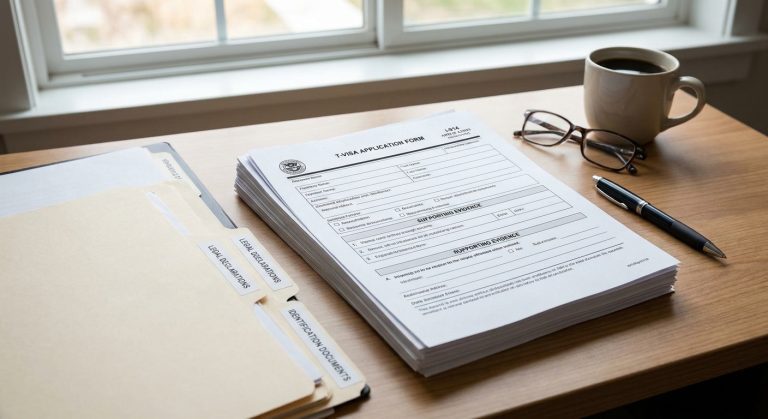
Organize your application packet clearly, placing the main Form I-914 on top, followed by any supplements and then your supporting evidence. USCIS prefers that you do not staple documents excessively or use binders. Consider using tabs to label different sections of evidence for easy review.

Where to mail your T Visa application
USCIS assigns Form I-914 to one of two lockboxes based on where you live. Texas residents and most southern and western states file with the USCIS Phoenix Lockbox. Illinois, New York and most northeast and Great Lakes states file with the USCIS Elgin Lockbox. Always verify the current address on the Form I-914 page at uscis.gov.
USCIS Phoenix Lockbox (Texas, California, Florida, Arizona, Georgia and similar states):
- USPS: USCIS, Attn: I-914, P.O. Box 20200, Phoenix, AZ 85036-0200
- FedEx, UPS, DHL: USCIS, Attn: I-914 (Box 20200), 2108 E. Elliot Rd., Tempe, AZ 85284-1806
USCIS Elgin Lockbox (Illinois, New York, Massachusetts and similar states):
- USPS: USCIS, Attn: I-914, P.O. Box 4221, Carol Stream, IL 60197-4221
- FedEx, UPS, DHL: USCIS, Attn: I-914 (Box 4221), 2500 Westfield Drive, Elgin, IL 60124-7836
Use a tracked mailing service (Certified Mail or traceable courier) so you have proof of submission.
After filing what to expect
After submitting your T Visa case, the process enters a review phase. Six milestones typically follow:
Steps from filing to final decision
- Receipt Notice: Within a few weeks of mailing, USCIS will send you a Form I-797C, Notice of Action, confirming receipt of your application. This notice will include a receipt number, which you can use to track the status of your case online.
- Biometrics Appointment: You will receive an appointment notice for a biometrics services appointment at an Application Support Center (ASC). At this appointment, your fingerprints, photograph, and signature will be collected for background checks.
- Request for Evidence (RFE): USCIS may send an RFE if they need additional information or clarification for your application. Responding to an RFE promptly and thoroughly is essential to avoid delays or denial.
- Bona Fide Determination (BFD):
USCIS will make a Bona Fide Determination, which is an initial finding that you have credibly alleged that you are a victim of human trafficking and are admissible.
If you receive a positive BFD, you will typically be granted work authorization (Employment Authorization Document, or EAD) and deferred action, protecting you from deportation while your T Visa application is pending.
- Interview: While not all T Visa applicants are interviewed, USCIS may schedule one to clarify information or confirm details in your application. An attorney can prepare you for this interview.
- Final Decision: After all reviews and any potential interviews, USCIS will make a final decision on your T Visa petition. If approved, you will be granted T Nonimmigrant Status.
Why the Bona Fide Determination matters most
The T Visa process can take time, but the protections offered during processing, especially after a BFD, are significant. Stay in contact with your legal counsel throughout this period to address any questions or requests from USCIS promptly.
If you are unsure about specific T Visa eligibility criteria, how to gather the right evidence of trafficking or cooperation, or what to expect after filing your T Visa application, contact our team and we will look at it with you.
Frequently asked questions about T Visa applications
What if I don’t have a police report for my trafficking?
A police report is strong evidence, but not always mandatory for a T Visa. We can help you gather other compelling documents like affidavits from you and witnesses, medical records, or statements from victim service organizations. The key is to provide credible evidence illustrating your trafficking experience.
Can my family members who are not in the U.S. apply for derivative T status?
Yes, certain eligible family members, such as a spouse or child, can apply for derivative T Nonimmigrant Status even if they are currently outside the United States. They would typically use Form I-914, Supplement A. Our team can guide you on their eligibility and the specific requirements for their petitions.
How long can I expect the T Visa application process to take?
The T Visa application process can vary significantly in length, generally taking several months to over a year for a final decision. Factors like the complexity of your case, USCIS caseloads, and any Requests for Evidence can influence the timeline. We help you stay informed throughout the process.
What if I am hesitant to cooperate with law enforcement for my T Visa?
Cooperation with law enforcement is a requirement, but it does not always mean testifying in court. It typically involves being willing to assist with investigations as reasonably requested. If you fear for your safety, we can discuss options to ensure your protection while still meeting this requirement.
What kind of protection does a positive Bona Fide Determination offer?
A positive Bona Fide Determination (BFD) is a significant milestone. It typically grants you work authorization (EAD) and deferred action, safeguarding you from deportation while your T Visa application is being fully processed. This offers important temporary security and stability.
Can I apply for a T Visa if I initially entered the U.S. legally?
Yes, your method of entry into the U.S. does not prevent you from being eligible for a T Visa. The key factor is that your physical presence in the U.S. (or a territory or port of entry) resulted from your experience as a victim of human trafficking.